RESOURCE CENTER
Home / Board Resources / HOA Board Support
BOARD MEMBER RESOURCES
How to Improve Homeowner Communication
A homeowner opens a letter from the association, reads the first line, and puts it down.
Most of what an association sends arrives at that kind of moment, when the news is a cost or a correction, and the reader has no context for either.
Communication gets better when owners hear from the association on a schedule, receive the reason along with the decision, and know where to take a question.
Introduce the association early
The first message a new owner receives sets expectations for the rest of the relationship. It should cover who to contact, how assessments are paid, where the governing documents are kept, and how architectural requests work. When Nova takes over management of a community, the onboarding process includes an early introduction to homeowners, which Nova calls Community Connection, so the first thing owners hear from the new team is a clear, friendly message.
A short welcome note is cheap to write and answers most of what a new owner would otherwise ask in the first month.
Give owners the reason behind a change
When the board raises assessments, owners read the notice looking for one thing: why. A short explanation answers that before anyone has to ask: the insurance renewal came in higher, or the landscaping contract was repriced. Nova’s financial management team prepares budgets using current vendor quotes rather than estimates, and the supporting documents go to the board along with the recommendation, so the board has what it needs to explain an increase to owners.
A special assessment deserves more than a letter. Owners should hear about it early, see the numbers and the alternatives the board considered, and have a chance to ask questions at a meeting, in person or online. Budget season and the annual meeting are the two points in the year when the whole community expects to hear from the board, and the annual board calendar shows where they fall.
Choosing the right communication channel
A water shutoff scheduled for Thursday morning needs to reach people Wednesday night, and an email sent Tuesday afternoon may not. Urgent notices like that travel better by text, which owners tend to see quickly.
Routine updates fit email, and documents belong in one place owners can find without asking anyone. Formal notices are different. The governing documents and state law usually specify how they have to be delivered, which sometimes still means mail or a posted notice, and the rules differ across states. The service area pages are a good starting point, and an attorney can confirm what applies to a specific association. Larger decisions still work best in a meeting, where owners can hear the discussion and ask their own questions.
Responding quickly
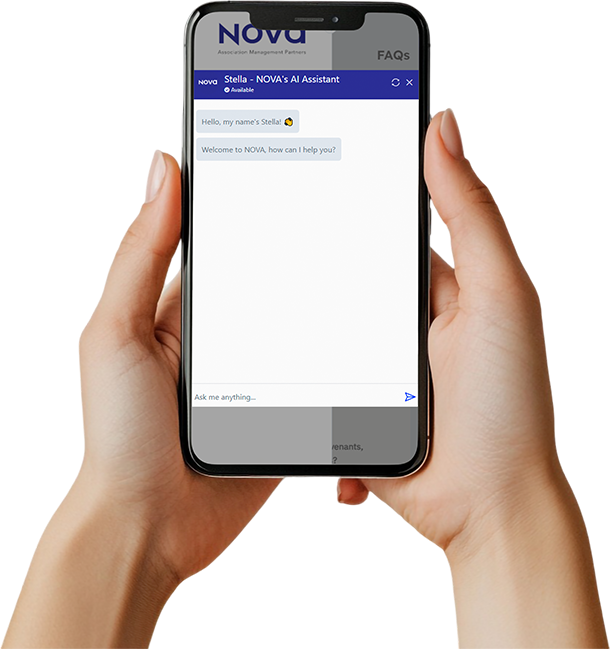
Owners tend to judge the association by how quickly somebody answers them. Nova’s Solution Team is available around the clock, and owners can reach it through portal requests, text, webchat, phone, or email. A digital assistant handles common questions through webchat and text at any hour, which keeps board members from becoming the front door for every question on a Sunday afternoon. It’s part of the Homeowner Experience®.
The system also gives the board visibility into owner communications. When a dozen owners ask about the same thing in a month, the answer belongs in a community-wide message.
Whatever response time the association aims for, every message should get an acknowledgment within one business day, even if the full answer takes longer. A note saying the board is checking and will reply by Friday is far better than silence.
Violation notices
The first notice sets the tone for everything that follows. It should name the rule, explain what needs to change and by when, and give the owner a way to talk to someone about it. Notices that leave out that last part tend to produce an angry phone call anyway, just later. Every notice should go out the same way regardless of who owns the property, and the association should keep a record of each one.
Answering the same questions once
Every community has a few questions that come up each year, like who is responsible for the fence between two units or when the pool opens. Townhome communities deal with the fence question constantly, because confusion over maintenance responsibility causes steady friction. A one-page chart showing who is responsible for what, posted where owners can find it, answers a lot of emails before it gets written.
After the board meeting
Most owners never attend a board meeting. A short summary of what the board decided, posted or emailed within a few days of each meeting, gives them the outcome without the two hours. Approved minutes belong in the same place as the other community documents. Owners who do want to attend can join virtually, which removes the biggest obstacle, and the forum guidelines for running effective board meetings keep those sessions useful.
NEXT STEP
Need help with the homeowner side?
Communication is usually the first thing to slip when volunteers get busy. If your board would rather have a team handling day-to-day homeowner communication, reach out to our team and we’ll walk through how our customized management solutions are set up for your community.
Frequently asked questions
How often should an HOA communicate with homeowners?
Quarterly works for routine updates in most communities, along with a message after each board meeting and another before budget season. Urgent items go out when they happen. Past monthly, people stop reading.
What's the best way to reach homeowners?
Email covers most of it, with paper or posting for anything the law or the governing documents require in writing. Text works for urgent items. Keep the contact list current, and make it easy for owners to update their information.
Should board members give out their personal phone numbers?
It’s better not to. A personal number turns a volunteer role into an on-call job, and answers given informally can create commitments the board never approved. Route questions through one shared channel instead.
How do we handle a homeowner who keeps sending angry emails?
Answer once, plainly, and point to the rule or the decision. Repeated back-and-forth rarely changes anything. If the messages turn abusive, the board can route everything through management and keep a record.
What should we send new owners?
The governing documents, payment instructions, and a contact list, with a one-page summary on top so nobody has to read a hundred pages to find out when dues are due.
Keep learning
Related Guides & Resources
GUIDE
Preventing HOA Board Burnout
Board burnout is one of the more common reasons HOA boards fall apart, and one of …..
guide
HOA Board Member Resource Center
Nobody hands a new board member a manual. Most people get elected, or just …..
GUIDE
How to Run More Effective HOA Board Meetings
A board meeting’s length gets decided before anyone sits down. Shorter meetings …..
Nova Association Management
Your board should be governing—not running the day-to-day operation.

Ask Stella Anything
Our digital assistant is here for you day or night to answer questions and deploy solutions immediately.