RESOURCE CENTER
Home / Board Resources / HOA Board Support
BOARD MEMBER RESOURCES
How to Run More Effective HOA Board Meetings
A board meeting’s length gets decided before anyone sits down.
Shorter meetings come from preparation. The agenda and supporting documents go out ahead of time, routine items get approved in one motion, and the minutes record what was decided instead of who said what. The rest is discipline about time and about who speaks when. Boards newer to the role can find the wider picture in the HOA Board Member Resource Center.
Send important information early
A packet that arrives right before the meeting gets skimmed over. However, one that arrives several days ahead gets read with ample time to digest the information, and that’s when the useful questions surface. Nova has used the name Meeting Optimization™ for this approach for years, and it sits inside Board Member Experience®: managers show up prepared, agendas stick to what needs a board decision, and supporting documents land early.
Questions sent to the Association Manager the day before usually get better answers than questions asked cold at the table. The manager’s side of the work between meetings, packet included, gets its own walkthrough in what an HOA management company does day to day.
Decisions first, reports second
The items that need a vote go at the top of the agenda, while everyone still has energy. Updates and reports come after. Any member can pull an item out for discussion, and most items never get pulled. A consent agenda only works when the statements are readable enough that board members have reviewed them beforehand, which is where financial management support earns its place. Nova’s monthly statements are built so a treasurer can read them without an accounting degree.
Every item gets a time estimate on the agenda, and the chair says it out loud. A complaint that was going to eat forty minutes gets ten, with a note to revisit it next month if it needs more.
The chair’s job is keeping the room moving and protecting the quieter members from the louder ones. “Let’s park that until next month” is a complete sentence, as long as it goes on the list.
The homeowner forum
Owners can generally attend open meetings, and a time-limited forum keeps their comments from swallowing the agenda. Put it near the start, state the limit before the first speaker (three minutes each is common), and treat it as listening time. The board doesn’t owe an answer on the spot. “We’ll follow up” is a complete response when something warrants review and response.
Most of what shows up in a forum is really a service request: a billing question, a gate code, a parking complaint. When those get answered through the Homeowner Experience® side of management before the meeting, the forum shrinks to the things that need a board.
Executive session
Some topics don’t belong in front of the whole room: legal advice, personnel matters, a specific owner’s delinquency. The bylaws and state law decide what can be discussed in closed session and what has to be reported back, and the rules differ between each state, so the service area pages are a starting point and an attorney has the final word. In many associations, the vote itself still happens back in the open meeting.
What the minutes should say
Minutes are the association’s memory, and in a dispute they become evidence. They should record who attended, each motion, who seconded it, and how the vote came out, plus any action item with a name and a date beside it. They shouldn’t read like a transcript, because a record of who said what turns a routine document into a liability the first time somebody requests it. Draft minutes should go out within a few days to fellow Board members, while people remember the meeting, and the board approves them at the next one.
Follow-through
Opening each meeting with the last meeting’s to-do items is the quickest way to keep a one-hour meeting from turning into a two-hour one. The items that slipped get named out loud, and the ones that got done get crossed off, which is more satisfying than it sounds.
Virtual and hybrid meetings
A hybrid meeting fails the moment the people on screen can’t hear the people in the room. Somebody needs to own the audio and the chat, and remote owners need a clear way into the forum when it opens. Nova’s Meeting Optimization™ includes virtual participation, which helps board members who travel for work and owners who don’t live in the community full time. A quick test of the setup before the meeting starts saves the first ten minutes.
Setting the rhythm early
When Nova takes over a community, the board meets with the team during the transition to agree on goals and get training, which is covered during the onboarding process. The first meeting under new management doesn’t start from scratch. Setting the following year’s meeting dates in December, as part of the annual board calendar, keeps the budget meeting from getting scheduled in a panic.
NEXT STEP
Want help getting meetings under control?
Every board runs differently, and the right level of support depends on how much of the preparation is landing on volunteers right now. If board meetings are eating more evenings than they should, get in touch with our team and we’ll walk through how our customized management solutions handle the preparation.
Frequently asked questions
How long should an HOA board meeting last?
Most run best at forty-five minutes to an hour. Past that, decisions get worse, and people stop reading the packet next time. If the agenda regularly needs more time, it’s usually carrying reports that could have been sent in advance.
Do board members need to follow Robert's Rules?
Only if the bylaws say so. Even then, a light version works: a motion, a second, discussion, and a vote. Full parliamentary procedure at a twelve-unit association tends to slow things down more than it protects anyone.
Can the board vote by email?
Rules on this vary. Some states allow action without a meeting only with unanimous written consent, and others restrict it further. Ask an attorney before making email votes a habit, since a vote taken the wrong way can be challenged later.
Do homeowners have to be allowed to attend?
Often, yes, at least for the open portion. State law and the governing documents decide, and closed sessions for legal and personnel matters are the usual exception. Check both before closing a meeting.
Who takes the minutes?
Traditionally, the secretary. Plenty of boards hand the drafting to management to free the secretary up. Whoever drafts them, the board approves the final version.
Keep learning
Related Guides & Resources
GUIDE
Preventing HOA Board Burnout
Board burnout is one of the more common reasons HOA boards fall apart, and one of …..
guide
HOA Board Member Resource Center
Nobody hands a new board member a manual. Most people get elected, or just …..
guide
How to Improve Homeowner Communication
A homeowner opens a letter from the association, reads the first line, and puts it down …..
Nova Association Management
Your board should be governing—not running the day-to-day operation.

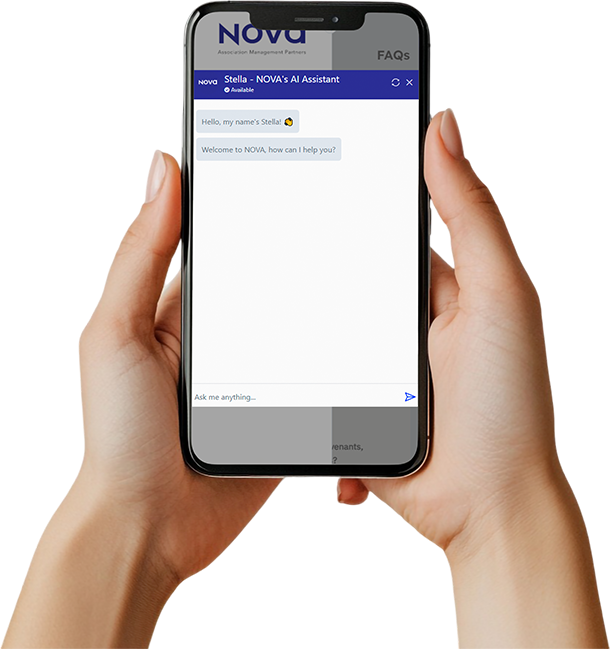
Ask Stella Anything
Our digital assistant is here for you day or night to answer questions and deploy solutions immediately.