RESOURCE CENTER
Home / Board Resources / HOA Board Support
BOARD MEMBER RESOURCES
Preventing HOA
Board Burnout
Board burnout is one of the more common reasons HOA boards fall apart, and one of the least talked about.
It rarely gets named as the problem while it’s happening. It shows up as a resignation, a rule that quietly stops getting enforced, or a board that goes flat for a few months before somebody finally says they’re done.
The early signs
Burnout rarely announces itself. It shows up first as response times getting a little longer and enforcement getting a little less consistent, and then as the people who used to volunteer for the hard conversations going quiet without saying why. None of it looks dramatic on its own, but given a few months to compound, it adds up to a board coming apart quietly instead of all at once.
Where the workload ends up
Burnout concentrates instead of spreading out evenly, since most of the real work on a board tends to land on whoever’s willing to chase a vendor bid, prepare a notice, or answer an email outside business hours, while the rest of the board shows up and votes. That imbalance is manageable for a while and stops being manageable once it’s had time to compound, and the people carrying most of it rarely say anything about it until they’ve already decided to leave.
Splitting the work by design
Nova tracks manager capacity with real data instead of leaving it to assumption, so a manager doesn’t end up quietly overloaded while everyone assumes things are fine. That’s also why the work splits into three roles instead of stacking on one person: an Association Manager on the board relationship, an Association Coordinator on escalations and project support, and the Solution Team on the homeowner side. Board service is supposed to stay a volunteer position, and that split is most of what makes an hour or two a month realistic instead of aspirational.
Shorter meetings help more than people expect
A two-hour meeting is its own burnout driver, and it’s usually a symptom of something upstream, an agenda that never went out ahead of time, or a meeting with no real limit on how long any one topic gets to run, which running more effective board meetings gets into in more detail. Most of what eats meeting time doesn’t need the full board’s attention every single month, and cutting meeting length gives every board member real time back over the course of a year.
Spreading the load on purpose
Staggered terms keep a board from losing everyone who understands what’s going on in the same election cycle. Committees help too, but only real ones, with actual ownership over a task instead of a title nobody follows up on. The difference between a board that burns out and one that doesn’t usually comes down to whether responsibilities get assigned to more than one or two people, not how capable anyone involved happens to be.
When the fix isn’t a better system
Some boards reach a point where the volunteers left are running on fumes; no committee structure will fix it. At that point, the honest answer is usually routing enough of the operational work off volunteers’ desks that the people left have something to volunteer for again.
NEXT STEP
Want to take some of this off your board’s plate?
If your board recognizes more of this than it would like to admit, get in touch with our team, and we’ll walk through how our customized management solutions handle the workload that’s been sitting on volunteers. The HOA Board Member Resource Center covers the rest of what board service involves.
Frequently asked questions
How do you know if a board is burned out, and not just busy?
Busy passes on its own. Burnout is a pattern that holds for months: the same people missing meetings, decisions getting punted instead of made, enforcement quietly sliding. If that pattern is still there after a couple of months, it’s burnout.
Does hiring a management company really reduce the workload, or just move it around?
It depends on what gets handed off. Plenty of management companies only touch the financials, which means the vendor calls, the homeowner emails, and the meeting prep are all still sitting on the board the next morning. Nova’s model covers that operational side too, not just the bookkeeping, which is the part that frees up a volunteer’s week.
How many people should be on a committee?
Two or three per area works better than one, since a committee of one is only a volunteer with a title. It also means the committee survives if one person has a busy month.
What’s a reasonable time commitment for a board member?
An hour or two a month for most volunteers, with more for the president or treasurer during budget season. If board members are regularly spending several hours a week, something upstream needs to change.
Can a board member step back without resigning outright?
Often, yes. Some boards allow a temporary leave of absence, with someone else covering committee duties in the meantime. Check the bylaws first, since not every association’s documents address it.
What can a board do this month, without hiring anyone, to reduce burnout?
Look at who’s carrying the real work versus who’s just voting, and move at least one real responsibility off the most overloaded person. Shorten the next meeting’s agenda to only what needs a decision. Neither costs anything, and both tend to show results faster than people expect.
Does board burnout affect anything beyond the volunteers themselves?
Yes. A burned-out board tends to defer maintenance, slow down on enforcement, and lose the institutional memory that makes good decisions possible. Homeowners usually notice the property before they notice why: a compliance letter that never went out, a project that never got a second vendor quote.
Keep learning
Related Guides & Resources
guide
HOA Board Member Resource Center
Nobody hands a new board member a manual. Most people get elected, or just …..
guide
How to Improve Homeowner Communication
A homeowner opens a letter from the association, reads the first line, and puts it down …..
GUIDE
How to Run More Effective HOA Board Meetings
A board meeting’s length gets decided before anyone sits down. Shorter meetings …..
Nova Association Management
Your board should be governing—not running the day-to-day operation.

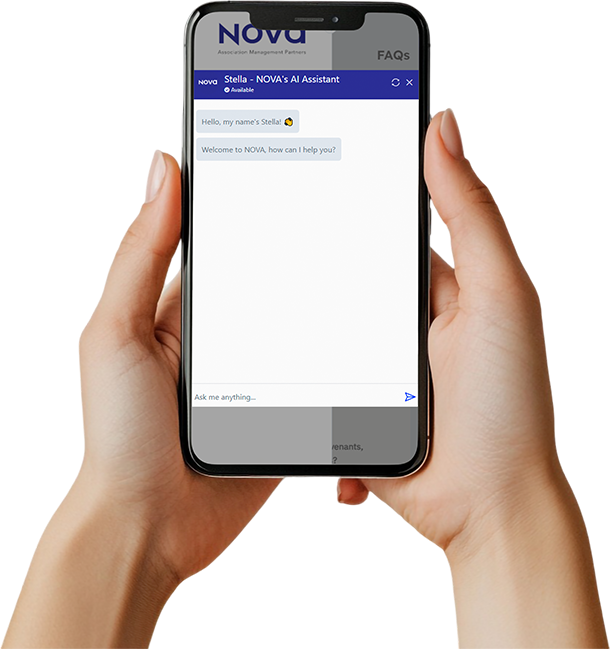
Ask Stella Anything
Our digital assistant is here for you day or night to answer questions and deploy solutions immediately.