RESOURCE CENTER
Home / Board Resources / HOA Management Education
BOARD MEMBER RESOURCES
HOA Board vs. Management Company Responsibilities
The board and the management company work together, but they are not doing the same job.
A new board member sits down for the first time and starts asking questions. Who approves the budget? Who hires the landscaper? Who answers homeowners when something goes wrong? Who is actually responsible for enforcing the rules?
The answer to most of those questions is, "It depends."
The board and the management company work together, but they are not doing the same job. The board governs the association and makes the decisions that belong to it. The management company handles much of the operational work that turns those decisions into something the community can actually carry out.
That distinction sounds simple until a real problem lands in someone’s inbox.
A vendor wants approval for a large repair. A homeowner is challenging a violation notice. The budget is coming in higher than expected. A board member wants to know why something was handled a certain way last year. Someone has to figure out what needs a board decision and what can simply be handled.
What the HOA board is responsible for
The board is ultimately responsible for governing the association.
That means setting policies, approving the budget, making decisions about major expenditures, overseeing the association’s direction, and acting within the authority provided by the governing documents and applicable law.
The management company does not replace that responsibility.
If the community needs to decide whether to approve a major capital project, the board makes the decision. If the budget needs to be approved, the board votes on it. If the association is considering a policy change, that decision belongs with the board.
A management company can bring information, recommendations, bids, financial reports, and professional experience to the discussion. The board still has to decide what the association is going to do.
That is an important distinction because professional management should make board members better informed, not less involved.
What the management company is responsible for
The management company’s job is to handle the operational work surrounding those decisions.
That can include coordinating vendors, preparing financial information, organizing board meetings, following up on maintenance, responding to homeowner questions, maintaining records, handling established compliance processes, and keeping projects moving.
The exact responsibilities depend on the management agreement and the community. A six-unit association may need something very different from a community with thousands of homeowners and multiple amenities.
Nova’s approach is built around customized management solutions rather than assuming every association needs the same package.
The goal is not to take decisions away from the board. It is to keep board members from spending their evenings doing the administrative work required to carry those decisions out.
Who makes the financial decisions?
The board does.
The management company may prepare the budget, keep all of the financial records, handle accounts receivable and accounts payable, provide reports, and explain what has changed from one year to the next. The board reviews that information and makes the decisions.
This is one area where the distinction can get blurry because the management company may be doing most of the financial work.
That does not mean the management company gets to decide how the association spends its money.
Nova’s financial management services are designed around that division. The management team handles the accounting and reporting work while the board retains decision-making authority over the association’s spending.
That gives board members something more useful than a spreadsheet full of numbers. They have the information they need to understand what is happening and make a decision.
Who handles vendors?
Usually, the management company handles the coordination. The board handles the decisions that require board approval.
A landscaping contract is a good example. The management team may communicate with the vendor, monitor the work, gather proposals, and bring recommendations to the board. If the contract requires a board decision, the board makes it.
The same thing happens with a larger repair.
A management company may investigate the problem, coordinate with contractors, obtain bids, and explain the options. The board then decides whether to move forward, which option makes sense, and how the expense should be handled.
That division keeps board members involved without requiring them to become project managers.
Nova’s Board Member Experience® specifically includes vendor relations and professional recommendations as part of the support provided to boards.
Who deals with homeowners?
This is one of the areas where responsibilities can overlap, but routine homeowner communication generally should not require the board’s attention.
A homeowner may want to know how to submit an architectural request. Someone may have a question about an assessment. Another resident may need help finding a document or reporting a maintenance issue.
Those are community management responsibilities, not usually board decisions.
Nova separates that work through the Homeowner Experience®. The Solution Team handles day-to-day homeowner questions and requests so the Association Manager can stay focused on the board relationship and the issues that actually require management judgment.
That matters for the board, too. When every homeowner question gets forwarded to a board member, volunteers can quickly find themselves doing customer service instead of governing the association.
Who enforces the HOA's rules?
The board establishes the association’s policies and is responsible for the decisions that govern enforcement.
The management company can carry out the established process.
That may mean conducting inspections, documenting potential violations, sending notices, maintaining records, and bringing questions to the board when a decision is required.
The important part is consistency.
If a homeowner asks why a notice was sent, the association should be able to explain what happened and what process was followed. The management company can help keep that process organized, but it should not be inventing rules or deciding major policy questions on its own.
The same principle applies to architectural requests. The management team can receive and organize applications, check them against the established process, and bring matters to the appropriate decision-makers. The board retains the authority that belongs to it under the governing documents.
Who runs the board meeting?
The board is still the board.
The management company should, however, make it much easier for the board to have a successful meeting.
That means getting the agenda organized, gathering supporting documents, preparing financial information, tracking open items, and making sure everyone has the information they need before the meeting starts.
Nova calls this Meeting Optimization™, part of its Board Member Experience® approach. The idea is simple. A board meeting should be a professional business meeting where decisions get made, rather than two hours of people trying to reconstruct what happened last month.
The board makes the decisions. The management company helps make sure the board has what it needs to make them.
What happens when the board and manager disagree?
The board does not have to accept every recommendation a management company makes.
A good management relationship should include professional advice, even when that advice is not what the board expected to hear. The management company may recommend increasing a budget line, replacing a vendor, addressing a maintenance issue sooner than planned, or getting additional information before making a decision.
The board can agree, disagree, ask questions, or request another option.
That is part of the relationship.
Nova’s approach stresses clarifying the rationale behind recommendations rather than simply handing a board a number or proposal and expecting approval. That gives board members the context they need to make their own decisions.
Why the difference matters
The biggest problem usually happens when the line between governance and operations disappears.
A board starts managing vendors directly. Then someone is answering homeowner emails. Another person is keeping the financial records. A third board member is trying to remember what happened with a repair two years ago.
At that point, the board is not just governing the association. It is running the day-to-day operation.
That can work for a while, particularly in a small community with highly involved volunteers. It gets much harder when the community grows, the workload increases, or the people carrying the institutional knowledge step away.
This is one reason Nova uses a team-based model. Association Managers focus on the board relationship, strategy, and decisions that require management expertise. Association Coordinators provide project and escalation support, while the Solution Team handles much of the day-to-day homeowner experience.
The board remains the governing body. It simply does not have to be the operations department, too.
What the board should expect from a management company
A management company should make the board’s responsibilities clearer, not create another layer of confusion.
Board members should know what decisions need their attention, what the management team is handling, what projects are underway, and what information they need to review.
They should also be able to find the records behind those conversations.
Nova’s systems give board members access to community documents and historical information rather than leaving everything in one person’s inbox. That shared access also means the management team can work from the same information when someone is unavailable.
That continuity matters more than it sounds. A board should not have to start over every time a manager takes a vacation, changes roles, or leaves the company.
The board still needs to be involved
Professional management is not a way for a board to disappear.
The board still needs to review financial information, make decisions, attend meetings, provide direction, and understand what is happening in the community. The difference is that board members should be spending their time on those responsibilities instead of chasing every invoice, homeowner question, and vendor update themselves.
Nova’s goal is to make board service feel like volunteer service rather than another full-time responsibility. Its Board Member Experience® is built around giving boards the information and professional support they need to lead while the management team handles the operational workload.
That is really the dividing line.
The board governs. The management company manages.
The two jobs work best when neither side is trying to do the other’s job.
What happens when responsibilities aren't clear?
Usually, somebody gets frustrated.
A board thinks the manager should have handled something. The manager assumes the board needs to make the decision. A homeowner gets sent from one person to another. A vendor waits for approval that nobody realized was still outstanding.
None of that requires bad intentions. It usually means nobody agreed on who was responsible for what.
That is why the management agreement matters. Before signing, boards should understand exactly what the management company handles, what requires board approval, how homeowner requests are handled, what financial responsibilities are included, and where additional decisions or services require board involvement.
Nova’s customer success and onboarding process starts by getting the management team and board in sync on goals, responsibilities, systems, and expectations. That conversation is much easier to have at the beginning than after everyone is already frustrated.
NEXT STEP
Ready to clarify who handles what?
There is no universal division of responsibilities that works for every association. A small self-managed community will operate differently from a large HOA with hundreds of homeowners, extensive common areas, and a long list of vendors.
The important thing is that everyone understands the arrangement.
The board should know which decisions belong to it. The management company should know what it has been hired to handle. Homeowners should know where to go when they need help.
If your board is spending more time managing the management company than governing the community, it may be worth looking at whether your current arrangement is actually working.
You can contact Nova to talk through what your community needs and where professional management could take some of the operational work off the board’s plate.
Frequently asked questions
Does the HOA board have more authority than the management company?
Yes. The board is responsible for governing the association and making decisions within its authority. A management company supports the board by handling operational work, providing recommendations, and carrying out decisions.
Can an HOA management company make decisions for the board?
A management company can make routine operational decisions within the authority given to it by the management agreement and established policies. Major decisions about the association’s finances, policies, governing documents, and other matters reserved for the board remain with the board.
Who is responsible for HOA finances, the board or the management company?
Both have different responsibilities. The management company may handle accounting, financial reporting, collections, payments, and budgeting support, while the board retains responsibility for approving the budget and making decisions about how the association’s money is spent.
Who handles homeowner complaints?
Routine homeowner questions and requests can generally be handled by the management company rather than the board. Nova’s Solution Team handles much of this day-to-day communication, allowing Association Managers to focus on board-level work.
Who hires HOA vendors?
The management company may research vendors, request bids, coordinate work, and make recommendations. The board typically makes the decisions that require board approval, particularly for significant contracts or expenses.
Does the board still need to attend meetings if there is a management company?
Yes. The management company supports and organizes the meeting, but the board remains responsible for governing the association and making the decisions that belong to it.
Keep learning
Related Guides & Resources
Nova Association Management
Your board should be governing—not running the day-to-day operation.

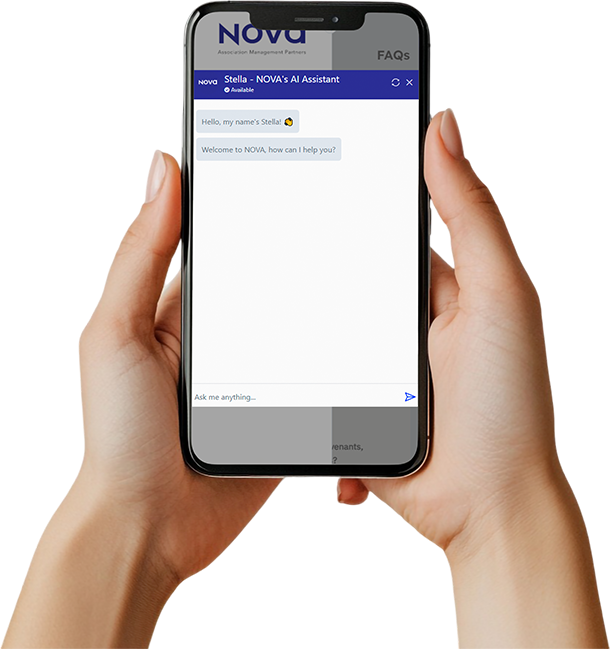
Ask Stella Anything
Our digital assistant is here for you day or night to answer questions and deploy solutions immediately.