Home / Board Resources / Developer Education
BOARD MEMBER RESOURCES
Building the First HOA Budget
The first budget is the one nobody can check against last year.
A new association has no prior statements, no spending history, and often no residents yet, so every line in the budget is a forecast. Some of those forecasts will be close, and some will miss badly, and the misses tend to show up after the developer has stopped covering them. A first budget that holds up usually comes from someone who has watched similar communities operate, and from a board that understands how each number got there. For the larger picture of how associations are run, our full guide to HOA management covers the basics.
A first budget is a forecast, not a record
Established associations build next year’s budget from the last twelve months of real bills. A brand new one can’t. The developer or its consultants estimate what landscaping, insurance, utilities, and management will cost, and the owners who close in the first year pay assessments based on those estimates.
The danger is that an estimate made before construction finishes can’t see the things that change once people move in. Amenities open in stages. Lawns that were irrigated by the builder now need a maintenance contract. A pool that sat empty during sales has to be staffed and cleaned all summer. Nova’s Developer Services addresses this by preparing projections ahead of construction that account for partial occupancy and staged amenity openings, and by drawing on data from comparable communities so the numbers reflect actual management costs and not generic estimates.
Start with the governing documents
Before any numbers go on paper, someone should read what the CC&Rs and bylaws require. Some documents mandate particular reserve contributions, set a minimum for insurance coverage, or specify which budget items the association must fund. Those requirements don’t bend because the budget looks tight.
State law adds its own layer. Washington, Oregon, and Montana each treat reserves and budget approval differently, so the service area pages are a good place to see what applies where. When Nova builds a budget, the team reviews the governing documents and state regulations for requirements that are easy to miss, and then works backward from the date the fiscal year ends. A first budget that skips this step can end up needing a revision before the first assessment is even collected.
Operating costs worth pricing carefully
Some line items cause more trouble than others in a first year. Insurance is usually the largest, and requirements for a community still under development differ from those of an established association, which is why Nova addresses insurance requirements, vendor costs, and reserve planning before the first closing. Landscaping and snow removal follow, along with utilities for common areas, repairs, and management fees.
Seasonal costs deserve special attention. A budget written in July by someone who has never watched a winter in that region will almost certainly underprice snow removal and winter damage repairs. In Montana, a heavy winter can use up a year’s snow removal allowance well before spring. In western Washington and Oregon, the cost is slower, with rain and moss turning up as repair bills spread across the year.
Vendor contracts matter here too. Contracts signed before residents arrive should fit the community as it exists on day one and be written to scale as new phases open, so the association isn’t renegotiating every time the neighborhood grows.
Reserves start on day one
Reserves are the part of a first budget that gets cut most often, usually because nothing looks broken yet. A new roof, a repaved road, or a resurfaced pool won’t be needed for years, so the temptation is to keep assessments low and deal with it later.
Later arrives, though, and the owners at that point pay for it. Nova starts reserve planning at the beginning, even when major capital needs are a decade away, because the cheapest time to fund a roof replacement is while the roof is new. A reserve study estimates what each common element will cost to repair and replace and when, and it gives the board a number to work toward. State law may set rules on reserve contributions, so a board should confirm what applies to its association before settling on a figure.
Reserves also have to be tracked separately from operating funds. Nova’s monthly financial packages use fund reporting, with operating and reserve money shown apart from each other, so a board can see at a glance whether the savings account is growing the way the study said it should. The Board Member Experience® is built around making that kind of information usable for volunteers.
What the developer is covering
Early budgets sometimes depend on the developer paying part of the cost of running the community, through subsidies or by paying assessments on unsold units at a reduced rate. This is common, and it isn’t a problem as long as everyone understands it.
It becomes a problem at turnover. Assessments that looked low for two years may have to rise sharply once the developer stops covering the difference, and owners who bought on the strength of those numbers are rarely happy about it. A first budget should show clearly what the developer is paying and what the owners would pay without that help, ideally with a plan for stepping assessments up over time. The same applies to anyone preparing for the transition from developer to homeowners, since a new board shouldn’t discover the real cost of running the community on its first day in charge.
Making the numbers readable
A budget nobody can follow doesn’t protect anyone. Owners live with it, and board members who’ve never read a financial statement shouldn’t need an accounting degree to understand where the money goes.
Nova’s financial management team aims for reports clear enough that non-accountants can understand them, and board members keep full authority over spending, including the ability to view and approve each invoice. During budget season, the team supplies support and templates, and builds tracking templates for the year so the board can compare real income and expenses against the plan as the months go by. Local CPAs who specialize in association accounting handle tax and audit work, which matters because an accountant unfamiliar with fund accounting can spend a client’s money learning how it works.
Checking the budget as the year goes on
A first-year budget will be wrong somewhere. What matters is how quickly the board notices.
Monthly statements compared against the plan show early which lines are running high. A landscaping bill that runs well over plan in the second month is a signal to look at the contract, not to wait for year-end. A board that reviews actuals every month can adjust spending, shift priorities, or, if needed, begin talking to owners about an assessment change before the situation turns into a crisis. The annual board calendar shows when budget work should start for the following year, and for most associations it begins months before the new fiscal year does.
Special assessments and the first surprise
Nearly every new community has a surprise in year one or two. A drainage problem turns up, irrigation costs run much higher than expected, or an amenity costs far more to run than expected. When the reserve is thin, the options narrow to a special assessment or a loan, and neither is pleasant for a young association whose owners are still getting to know each other.
A board that has built a cushion into the first budget, and understands what the governing documents say about special assessments, can face these surprises with some room to maneuver. Boards that have no cushion tend to lose trust fast. Owners remember who told them about a charge and when, and they remember it for a long time.
Where a management team comes in
A developer building out a community, or a first elected board inheriting one, doesn’t have to price all of this alone. Nova’s team works with developers from the earliest planning stages and stays with the association through turnover, the onboarding process, and the 60-day success review that follows. The Association Manager is a regular presence at board meetings and arrives with the numbers organized, so the first board isn’t reading a financial packet for the first time in the middle of the meeting.
NEXT STEP
Ready to build a first budget that holds up?
Whether the community is still being built or has just closed on its first homes, a budget based on comparable communities and real local costs gives the association a steadier start. If you’d like to talk through a new development or a first board’s budget, reach out to our team and we’ll walk through how our customized management solutions fit your community. The full guide to HOA management is a good next read for the rest of what running an association involves.
Frequently asked questions
Who writes the first HOA budget?
In most new communities, the developer prepares it, often with help from a management company or consultants, and the developer-appointed board adopts it. Once homeowners take control, the elected board approves every budget after that.
How far ahead should a first budget be prepared?
Before the first homes close, and early enough that the numbers can be checked against the governing documents and state requirements. Projections made before construction should account for partial occupancy, since costs rise as more homes are occupied and amenities open.
Should a new association fund reserves right away?
Yes. Reserve planning starts at the beginning, and a reserve study gives the board a target. State law may also set requirements, so the board should confirm what applies. Putting it off tends to mean larger assessments for later owners.
What if the first budget turns out to be too low?
The board can adopt an amended budget or raise assessments in line with the governing documents. Small, steady adjustments are easier on owners than one large jump, which is another reason to review actual spending every month.
Does the developer pay assessments on unsold homes?
Often, though the amount depends on the governing documents and any agreement the developer made with the association. Some developers pay full assessments and others cover shortfalls. Either way, a clear record of what the developer pays helps the first owner-elected board plan ahead.
Keep learning
Related Guides & Resources
Nova Association Management
Your board should be governing—not running the day-to-day operation.

Ask Stella Anything
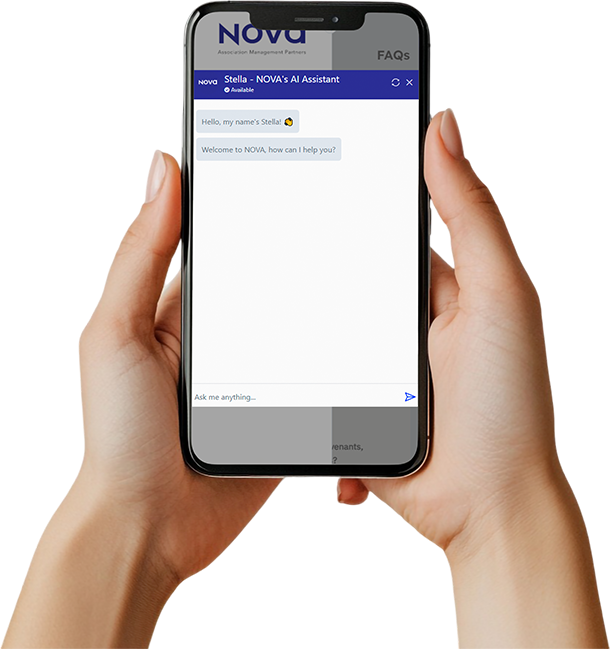
Our digital assistant is here for you day or night to answer questions and deploy solutions immediately.