Home / Board Resources / Developer Education
BOARD MEMBER RESOURCES
Developer Turnover Checklist
Turnover day is easy to schedule and hard to do well.
The developer hands over control, the new board takes its seats, and a lot of paperwork changes hands in a single afternoon. Most of what goes wrong afterward can be traced to something nobody asked for while the developer was still around to answer. This checklist walks through what a new board should request, confirm, and decide, in roughly the order it comes up. For the background on how the handoff works, start with our guide to the transition from developer to homeowners.
Before the turnover meeting
Start by reading the governing documents to see what triggers turnover and what the developer owes the association when it happens. Some documents spell out the records the developer must deliver, and others say very little, so knowing which kind you have shapes everything that follows. State law adds requirements of its own, and the rules differ across Washington, Oregon, and Montana. The service area pages are a reasonable place to see how each state approaches it, and the association’s attorney can confirm what applies to your project.
Next, put the request for records in writing. A written list with a date attached is much easier to follow up on than a hallway conversation. If the community is being built in phases, ask which phases are covered by this turnover and which stay under developer control, since the answer decides whose records you’re entitled to and when.
Nova tracks the turnover milestones laid out in the governing documents, so the calendar doesn’t depend on anyone remembering the trigger. It also provides pre-turnover education for homeowners who plan to serve, which gives a first board some footing before the first elected meeting.
The documents to ask for
The recorded governing documents come first, including every amendment and any rules and regulations the developer adopted. After those, ask for the association’s financial records: statements, the current budget, budget history, and any record of developer subsidies or unpaid assessments. A first board should know what the developer has been covering, because that support often ends at turnover. Our piece on building the first HOA budget explains why that gap catches new boards off guard.
Insurance policies belong on the list, along with certificates and claim history. So do the vendor and service contracts, with their terms, renewal dates, and cancellation clauses. Ask for plans, specifications, and as-built drawings for the common areas, because repairs get much harder when nobody can say where the irrigation lines run. Warranty paperwork for the buildings, roofs, and mechanical systems should come over as well, along with any reserve study the developer commissioned.
Association records that sit in the developer’s own files are the ones most likely to go missing. Nova keeps financial records, vendor contracts, meeting minutes, and historical correspondence in a cloud-based system from the start, so a community that was managed by Nova during development already has those documents in the association’s hands before turnover.
What to verify before accepting the numbers
Receiving a financial package isn’t the same as understanding it. Someone qualified should review the books, and ideally someone who knows association accounting, since the work is different from ordinary business bookkeeping. Nova works with local CPAs who specialize in association accounting, and its financial reporting keeps operating funds and reserve funds apart, so the board can see how much belongs to each.
Check that the account balances, the assessment receivables, and the owner ledgers reconcile with the statements. Look for any money the developer owes the association, such as unpaid assessments on lots it still owns or contributions that were promised and never made. If the developer paid certain bills out of pocket during the sales period, the new board should know about it before the first budget meeting, not after a vendor calls.
Reserves deserve their own look. If a reserve study exists, find out when it was done and whether the funding level it recommended has been followed. If none exists, commission one early. A board holding a reserve study can set assessments with a realistic picture of what the common elements will cost to replace.
At the meeting itself
The turnover meeting is usually procedural. Owners elect the board, the developer’s representatives resign, and the keys, passwords, and files change hands. It helps to bring a copy of the records request so each item can be checked off as it arrives, and to note anything that’s missing in the minutes, with the date and the name of the person who promised to deliver it.
A first board shouldn’t try to decide too much on turnover day. Electing officers, confirming the insurance is in force, and setting the next meeting date are enough. Under the Board Member Experience®, Nova’s Association Manager attends with an organized agenda and supporting documents, so a board of first-time volunteers isn’t working out the meeting format while the room is watching.
The first thirty days
Once the meeting ends, the real work begins. The new board should familiarize themselves with the governing documents, and the annual calendar to get an idea of what they are overseeing, and what is to come for the rest of the year. Nova’s management team works closely with the new Board after turnover making sure basics of the Board’s role are understood, best practices are shared, and expectations align.
Nova’s onboarding process covers much of this ground. Preparation begins about thirty days before management starts, with the team setting up its systems, reviewing documents, and introducing itself to homeowners. After that, a 60-day success review looks at how the new board is doing, and Nova keeps checking in. Guidance for first elected boards continues after turnover, and Nova’s goal is for board members to spend roughly an hour a month on their responsibilities.
Different communities, different checklists
Not every handoff looks the same. A small townhome community might receive a handful of binders, while a condominium with a shared building has insurance and structural records that need much closer attention. A master-planned community may turn over in sections over many years, and each section brings its own documents and its own board.
NEXT STEP
Need help with the handoff?
A turnover is easier with people who’ve seen several of them. If your board is approaching one, or you’re a developer planning ahead, reach out to our team and we’ll talk through how our customized management solutions and Developer Services fit your project. For the wider picture of how associations are run, the full guide to HOA management covers the rest.
Frequently asked questions
When does developer turnover happen?
The governing documents and state law decide. Many tie it to the sale of a set share of the units, to a date, or to both, and phased communities may turn over in stages. The association’s attorney can confirm the exact trigger for a given project.
What records should a developer hand over?
At minimum, the governing documents and amendments, financial records and budget history, insurance policies, vendor contracts, plans and as-built drawings for the common areas, warranty paperwork, and any reserve study. Requirements vary, so put the request in writing and keep a copy.
What if records are missing after turnover?
Document exactly what’s missing and when it was requested, then raise it with the association’s attorney. Gaps in records are common, and a written trail makes them easier to resolve.
Do we need a management company at turnover?
Not every board does, but a handoff is when first-time volunteers have the most to learn and the least history to lean on. Many new boards find that professional support in the first few months keeps the workload realistic.
Keep learning
Related Guides & Resources
Nova Association Management
Your board should be governing—not running the day-to-day operation.

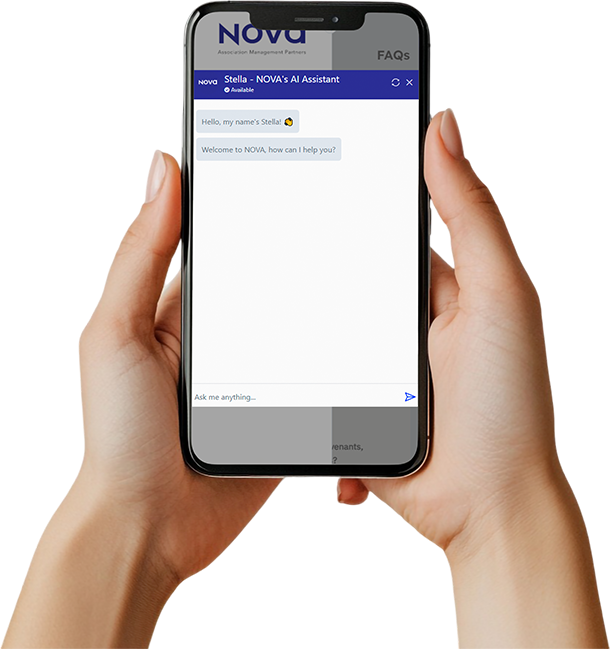
Ask Stella Anything
Our digital assistant is here for you day or night to answer questions and deploy solutions immediately.