RESOURCE CENTER
Home / Board Resources / HOA Management Education
BOARD MEMBER RESOURCES
HOA Management Fees Explained
The first thing most boards want to know when they start talking to a management company is pretty simple: How much is this going to cost?
That’s a fair question. HOA management fees are an ongoing expense, and the board has a responsibility to make sure the association is getting something worthwhile in return.
The harder question is figuring out what you’re actually comparing.
One company may quote a lower monthly fee but charge separately for services another company includes. Another may cost more because it provides a larger team, more homeowner support, or more financial services. Two proposals can have very different numbers at the bottom and still cover very different amounts of work.
There isn’t one management fee that makes sense for every community. Nova works with associations ranging from six-unit communities to developments with thousands of units, so its management approach is built around what each community actually needs rather than a single standard package.
What does an HOA management fee cover?
The answer should be spelled out in the management agreement.
Depending on the community and the services selected, a management fee may cover much of the day-to-day work required to operate an association. That can include board support, financial administration, vendor coordination, homeowner communication, maintenance follow-up, records, compliance support, and meeting preparation.
The important part is not just the list. It’s how much work sits behind each item.
“Financial management,” for example, can mean much more than depositing assessment payments and paying bills. A management team may also handle accounts receivable, collections, accounts payable, financial reporting, budgeting, tax preparation, and audit support.
Nova’s financial management services cover those areas and are also available separately for communities that don’t need full management.
That distinction matters when you’re comparing proposals. If one company includes professional accounting and another leaves most of the financial work with the board, the two monthly fees aren’t really measuring the same thing.
Why HOA management fees vary
There is no universal price because there is no universal HOA.
A small association with limited common areas may have a relatively straightforward operation. A larger community might have several amenities, numerous vendors, substantial reserves, more homeowner communication, and projects that require regular oversight.
The number of homes matters, but it isn’t the only thing that affects the workload.
A community with 75 homes and an aging pool, private roads, multiple landscaping contracts, and a history of financial problems can require more management attention than another 75-home community with very little common property.
The type of association matters, too. A condominium, master-planned community, townhome association, and large-scale HOA all have different responsibilities and operating issues.
That’s one reason Nova emphasizes customized management solutions instead of treating every association as though it needs the same level of support.
Does the cheapest HOA management fee mean the best deal?
Not necessarily.
A lower monthly fee can look great when the board is comparing proposals, especially when everyone is trying to keep assessments under control. The problem is that the lowest number doesn’t tell you how much work the board will still be doing.
Look closely at what’s included.
If the management company charges less but the board is still expected to handle homeowner calls, coordinate vendors, prepare parts of the meeting, chase delinquent accounts, or manage certain projects, the association may be paying less in management fees while spending more volunteer time.
That’s one of the reasons Nova’s management model puts so much emphasis on the Board Member Experience®. The company’s stated goal is to keep board service manageable by taking on much of the operational burden, rather than simply providing a manager who passes tasks back to the volunteers.
The fee should be evaluated against the workload the association is actually getting off the board’s plate.
What's usually included, and what's worth asking about?
This is where boards need to read the proposal carefully.
Ask about whether the monthly fee includes the basics, like must-have regular board meetings and preparation, financial reporting, resident communication, vendor coordination, property inspections, violation enforcement, collections, and routine maintenance.
Then ask what isn’t included.
Some services may be available for an additional charge, particularly work that falls outside normal management responsibilities. Large projects, special meetings, extensive document work, or other unusual requests may be treated differently depending on the agreement.
There is nothing inherently wrong with that. The problem is finding out about those charges after the board has already signed.
A good proposal should make the boundaries clear enough that the board can estimate its real annual cost.
What about financial management fees?
Financial management deserves its own conversation because an association can use professional financial services without necessarily hiring a company for full management.
Nova’s financial-only services are designed for communities that want to keep handling their own operations but need professional help with accounting, collections, reporting, budgeting, tax preparation, or audits. The board remains in control of operational decisions while the financial work is handled by professionals.
That can be useful for a board that has a good handle on vendors and homeowner communication but doesn’t want a volunteer treasurer responsible for specialized HOA accounting.
It also gives boards another option when they are comparing costs. The decision doesn’t always have to be full management versus doing everything yourself.
How much should a management company be doing for the fee?
A useful way to look at the fee is to ask what the board is actually getting back in time, expertise, and support.
A manager who is spending most of the day answering routine homeowner questions has less time to prepare for a board meeting or work through a complicated vendor issue. Nova addresses that with a team structure in which the Solution Team handles much of the homeowner experience while the Association Manager focuses on the board relationship and larger decisions. Association Coordinators provide project and escalation support.
That structure is tied directly to Nova’s approach to manager capacity. The company tracks a manager’s “circle of influence” to understand how much responsibility that person can realistically handle and when additional support is needed.
For a board, that can matter more than whether one proposal is $100 less per month.
Don't forget about homeowner service
Homeowner communication can be easy to overlook when boards compare management fees.
A proposal might say “customer service” without explaining what that actually means.
Who answers when a homeowner has a question? How quickly do they respond? Are there any limits on communication with owners to consider? Does every question go directly to the Association Manager? Can homeowners find documents and information themselves through a portal?
Nova’s Homeowner Experience® separates much of that day-to-day work from the manager’s board responsibilities. The Solution Team handles homeowner interactions so Association Managers can spend more time on board-level work.
That’s part of what a board should be evaluating when it compares management fees. Good homeowner service has a cost, but so does leaving the board to handle it themselves.
How technology can affect the value of a management fee
Technology won’t make an HOA management fee disappear, but it can change how much work a management team can handle and how much information the board has access to.
Nova uses shared cloud-based systems so board members can access community records and historical information instead of relying on one person’s inbox or a filing cabinet. The management team works from the same information, which also helps when someone is unavailable.
Nova also uses Optics 360 for property documentation and compliance work. Vehicle-mounted cameras capture community footage, which team members review for potential violations, and the footage is can be retained for future reference.
When you’re comparing management companies, ask how technology is actually being used. “We have a portal” isn’t particularly useful if nobody is keeping the information in it current.
What should a board ask before signing?
Start with the monthly fee, but don’t stop there.
Ask the company to explain exactly what the fee covers and which services are billed separately. Find out how many board meetings are included, what financial work is part of the agreement, how homeowner communication is handled, and who coordinates vendors and maintenance.
Ask what happens when the manager is on vacation or out sick. If the answer is that someone else simply picks up the manager’s email, you may want to ask a few more questions about how the team shares information.
It’s also worth asking how the company handles large projects and whether the board will receive recommendations or simply vendor proposals to review.
Nova’s management approach is built around professional guidance, organized information, and a team structure rather than a single person handling every responsibility. Its Board Member Experience® includes meeting preparation, professional recommendations, vendor coordination, and support with larger community decisions.
Look at the annual cost, not just the monthly number
A monthly management fee can make a proposal easy to compare at first glance.
The better comparison is the expected annual cost, including any additional fees that could reasonably come up during the year.
If one company charges a lower monthly rate but adds fees for meetings, inspections, project administration, or other routine work, the difference can disappear quickly.
Ask each company to walk through a realistic year for your association. What happens during budget season? How are meetings handled? What happens when a major repair comes up? How are homeowner questions handled? What happens if the board needs additional support?
You want to understand what the association will spend during an actual year, not just what appears on the first line of the proposal.
The cheapest fee can still be expensive
There is a reason Nova’s leadership talks so much about manager capacity and retaining good managers.
The industry can become focused on price, but pushing management fees down too far can put pressure on the people responsible for delivering the service. Nova’s leadership specifically described its focus on attracting and retaining quality managers rather than competing primarily on price, with manager capacity tracked through its “circle of influence” approach.
For a board, that becomes a service question.
If the management fee is low because one manager is carrying too many communities, the association may eventually pay for that savings through slower responses, missed follow-up, or board members having to step back in and handle work themselves.
A management fee should buy more than access to a manager’s email address.
It should buy the support the community actually needs.
What should a good management proposal tell you?
By the time a board is ready to compare proposals, it should have a pretty clear picture of what each company will actually do.
The proposal should explain the services included, the responsibilities that stay with the board, any additional fees, and how communication will work. It should also give the board a sense of who will be responsible for the relationship and what kind of support exists behind that person.
Nova’s approach is team-based rather than built around one manager handling everything. That includes Association Managers, Association Coordinators, and the Solution Team, with shared access to community information so the association isn’t dependent on one person’s memory or availability.
That is worth understanding before you compare the numbers.
NEXT STEP
Ready to compare what your community actually needs?
There isn’t a single HOA management fee that makes sense for every association. The right cost depends on the community’s size, complexity, services, and how much work the board wants the management team to take on.
Nova builds customized management solutions around those differences rather than forcing every community into the same arrangement.
If your board is comparing management proposals, thinking about a change, or simply trying to figure out whether you’re getting enough for what you’re paying, contact Nova to talk through your community’s needs.
Frequently asked questions
How much does HOA management cost?
There isn’t one standard price. Management fees vary based on the size and complexity of the community, the services included, the level of homeowner support, financial responsibilities, meeting requirements, and other management needs. The best way to compare costs is to look at the complete scope of services rather than the monthly fee alone.
Are HOA management fees usually paid by the HOA?
Yes. Management is generally an association operating expense paid from the community’s funds, which ultimately means the cost is reflected in the association’s budget and assessments. The board should understand where the management expense fits within its overall budget.
What is usually included in an HOA management fee?
It depends on the management agreement; for example, services may include financial administration, board meeting support, vendor coordination, homeowner communication, maintenance follow-up, records, and compliance-related work. Boards should review the agreement carefully to see which services are included and which may carry separate charges.
Can an HOA negotiate management fees?
Boards can discuss pricing and scope with a management company, particularly when the community’s needs are unusual or when the board is comparing proposals. It is important to compare the services being offered rather than negotiating only for the lowest monthly number.
Why are some HOA management companies more expensive than others?
The difference can come from the amount of work included, the level of financial and homeowner support, staffing, technology, meeting support, project coordination, and other services. A higher fee isn’t automatically better, just as a lower fee isn’t automatically a better value.
Does Nova offer financial management without full HOA management?
Yes. Nova offers financial-only services for communities that want to keep their operational responsibilities in-house while getting professional support with accounting, collections, budgeting, financial reporting, tax preparation, and audit preparation.
Keep learning
Related Guides & Resources
Nova Association Management
Your board should be governing—not running the day-to-day operation.

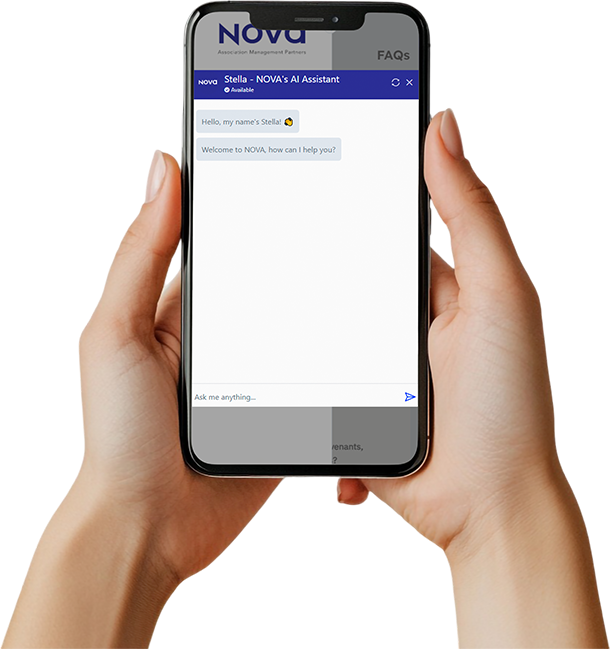
Ask Stella Anything
Our digital assistant is here for you day or night to answer questions and deploy solutions immediately.