RESOURCE CENTER
Home / Board Resources / HOA Management Education
BOARD MEMBER RESOURCES
Self-Managed HOA vs. Professional HOA Management
A board can run an HOA without a management company. In fact, plenty of them do.
Maybe the community is small, the board members have been around for years, and everyone knows who to call when the pool pump breaks. Dues get collected. The landscaping company shows up. Someone sends out the annual meeting notice. For a while, self-management can feel like the obvious choice.
Then the treasurer gets a new job. The board president moves. The person who knew where all the records were kept steps down. Suddenly, three people are trying to divide up a job that used to belong to one very organized volunteer.
That is usually when the question changes from “Can we manage this ourselves?” to “How much work are we actually asking volunteers to do?”
The answer depends on the community. A small association with simple operations may be perfectly capable of handling much of its own management. A larger community with multiple vendors, aging infrastructure, complicated finances, or a high volume of homeowner questions has a different set of demands.
What self-managed HOA management actually means
Self-managed does not mean nobody manages the association. It means the board and other volunteers are doing the management work themselves.
Someone has to collect and track assessments. Someone has to review invoices, coordinate vendors, answer homeowner questions, keep records organized, prepare for meetings, handle architectural requests, follow through on maintenance, and keep an eye on compliance with the governing documents.
In a small community, those responsibilities may be manageable. A board member might have the time and experience to handle the books, another may know the local contractors, and everyone may be comfortable answering homeowner questions.
The problem usually isn’t one task. It’s the accumulation of all of them.
A board meeting that takes two hours is one thing. Spending another three hours beforehand finding the documents, getting vendor updates, putting together the agenda, answering emails, and figuring out what needs a vote is something else.
That time is easy to underestimate because much of it happens between meetings.
The biggest advantage of managing the HOA yourself
The obvious advantage is cost.
A self-managed association doesn’t have a professional management fee in the budget, and that can bring a meaningful difference for a smaller community trying to keep assessments under control.
There is also a feeling of control that comes with doing things yourself. Board members know the homeowners. They know the history of the community. They aren’t waiting for someone outside the neighborhood to explain why the landscaping contract changed or what happened with a repair six months ago.
For some associations, that works well.
There is no rule saying every HOA needs a full-service management company. In fact, some communities choose a middle ground. They continue handling routine operations themselves while bringing in professional help for specific areas, particularly finances. Nova’s financial management services, for example, can support associations that want to remain hands-on with operations yet need professional help with accounting, collections, budgeting, or reporting.
That kind of arrangement can make sense when the board knows exactly which responsibilities it can handle and which ones are becoming a problem.
Where self-management starts to get harder
The workload tends to show up in small pieces: for example, a homeowner emails about a violation notice, or a vendor needs someone to approve a change order. None of those things is particularly unusual.
The problem is that they all belong to someone.
On a self-managed board, that someone is usually a volunteer who already has a job, a family, and plenty of other things competing for their attention. If that person is unavailable, the work moves to somebody else.
Eventually, board service starts to feel less like volunteering and more like an unpaid part-time job.
That’s one of the problems Nova’s Board Member Experience® is designed to address. The goal isn’t to take governance away from the board. It is to take much of the operational workload off the people who volunteered to govern the association in the first place.
What professional HOA management changes
Hiring a management company doesn’t mean the board gives up control.
The board still approves budgets, establishes policies, makes decisions under the governing documents, and remains responsible for governing the association. The management company handles the operational work and provides recommendations and support.
That distinction matters.
A professional management company can prepare the information the board needs, coordinate vendors, handle routine homeowner questions, keep records organized, and make sure decisions actually turn into completed work. The board can spend its time deciding what should happen instead of chasing down whether it happened.
Nova’s professional HOA management model is built around that division of responsibility. The company works with communities ranging from small associations to developments with thousands of units, with management arrangements built around what each community actually needs.
The financial question is bigger than bookkeeping
Money is one of the areas where the difference between self-management and professional management can become especially noticeable.
A volunteer treasurer may be perfectly comfortable paying invoices and reconciling an account. That doesn’t necessarily mean the association has a good long-term financial process.
Professional financial management gives the board another layer of experience and accountability. It also gives board members someone to call when a number doesn’t make sense instead of expecting a volunteer to figure it out alone.
Homeowner communication becomes a job of its own
This is another place where self-management can look easy until the volume increases.
One homeowner has a question about an assessment. Another wants an update on an architectural request. Someone can’t access the gate. Another resident wants a copy of the governing documents.
One or two questions aren’t a big deal.
Thirty questions in a week is different.
Nova separates this work from the board-facing management relationship through its Homeowner Experience®. The Solution Team handles routine homeowner interactions so Association Managers can spend more of their time working with boards on issues that require experience and judgment.
That separation is important because homeowner service can easily consume the same hours a board expects its manager to spend preparing for meetings, reviewing projects, and helping with larger decisions.
One person shouldn't have to know everything
This is one of the biggest differences between self-management and Nova’s approach.
On a self-managed board, knowledge often lives with specific people. The treasurer knows the financial history. The board president knows the vendor relationships. Someone else has the login to the old document system. When one of those people leaves, the association can lose a surprising amount of institutional knowledge with them.
The same thing can happen with a traditional management company if one manager is responsible for everything.
Nova uses a team model instead. Association Managers focus on board relationships and decisions that require management expertise. Association Coordinators provide project and escalation support. The Solution Team handles much of the day-to-day homeowner communication.
The point isn’t simply to have more people involved. It’s to keep one person’s absence from becoming the community’s problem.
Technology matters, but it doesn't replace people
A self-managed board may have plenty of software and still struggle to find the information it needs.
The issue is often not whether the association owns a system. It’s whether the records are actually organized and accessible.
A new board member shouldn’t have to spend a Saturday digging through five years of email to figure out why a project was approved. A treasurer shouldn’t have to ask one former board member for a financial report every time a question comes up.
Nova’s model keeps community information in shared systems so board members and the management team can access the same history. Property documentation can also provide a record of what was happening on the property over time.
Technology doesn’t make the decision for the board. It gives the people making the decision better information.
When does it make sense to hire a management company?
There isn’t one unit count or dollar amount that automatically means an association needs professional management.
A better question is whether the board can consistently handle the work without sacrificing other responsibilities.
It doesn't have to be all or nothing
One of the biggest misconceptions about this decision is that a board has only two choices: do everything itself or turn everything over to a management company.
That’s not necessarily the case.
Some associations want comprehensive professional management. Others need help with a particular part of the operation while keeping more responsibility in-house. A community might be comfortable handling homeowner communication but want professional financial monitoring. Another might have strong finances but need help coordinating vendors and larger projects.
That’s why Nova approaches management as customized management solutions rather than a single package that every community receives.
The right question isn’t whether professional management is always better than self-management. It’s whether the arrangement you have now is working for your board, your homeowners, and the community itself.
What should a board consider before deciding?
Start with the workload, not the management fee.
Add up the actual hours board members spend each month on financials, meetings, homeowner questions, vendors, maintenance, records, compliance, and everything else that is missed. Then look at who is doing that work and what happens when they’re unavailable.
Next, look at the complexity of the community. A small association with limited common property has different needs from a large community with multiple amenities, large-scale infrastructure, and hundreds or thousands of homeowners.
Finally, ask whether the current arrangement is sustainable.
If the board has a good system, people are willing to volunteer, records are organized, homeowners are getting answers, and the finances are being handled properly, self-management may be working just fine.
If the board is spending its volunteer time doing the work of a management company, the savings may not be as meaningful as they look on paper.
What happens if you decide to switch?
Moving from self-management to professional management doesn’t have to mean throwing everything out and starting over.
The community already has its own governing documents, financial history, vendor relationships, meeting records, homeowner information, and institutional knowledge. A good transition should keep that information rather than make the board start over.
Nova’s customer success and onboarding process starts before the official management date, giving the team time to gather information, review documents, prepare systems, communicate with homeowners, and work with the board before the transition is complete.
That preparation matters. The goal is for the community to feel like it gained support, not like it lost control.
NEXT STEP
The right answer depends on your board
Self-management isn’t automatically a bad idea, and professional management isn’t automatically the right answer for every association.
The real question is whether the people responsible for the community have the time, information, experience, and support to keep everything moving.
For some boards, the answer will be yes. For others, bringing in professional help gives volunteers the chance to get back to what they actually signed up to do: govern the community, make decisions, and help shape where it goes.
If you’re trying to decide which approach makes sense for your association, the Nova team can talk through what your community actually needs rather than starting with a standard package.
Frequently asked questions
Can an HOA manage itself?
Yes. A board can handle many or all of the association’s operational responsibilities itself. Whether that makes sense depends on the size and complexity of the community, the experience of the volunteers, and how much time they can realistically commit.
Is self-managing an HOA cheaper?
It can be. The association isn’t paying a management company, but that doesn’t mean the work disappears. Board members still have to keep up with financials, vendors, homeowner questions, maintenance, meetings, and records. What looks cheaper can end up taking quite a bit of volunteer time.
Does hiring an HOA management company mean the board loses control?
No. The board still makes the decisions and remains responsible for governing the association. The management company handles the day-to-day work, helps keep things moving, and gives the board information and recommendations to consider.
Can an HOA get professional help without hiring a full-service management company?
Yes. Some communities handle certain responsibilities themselves and bring in professional help where they need it most. For example, a board may be comfortable managing vendors and homeowner communication but want professional help with financial management. It really comes down to what the community needs and where the board could use some extra support.
How do you know when an HOA has outgrown self-management?
Look at the workload and whether it is sustainable. Long meetings, delayed homeowner responses, financial tasks falling behind, vendor problems, disorganized records, and the same few volunteers doing most of the work are all signs that the current arrangement may no longer be working.
Keep learning
Related Guides & Resources
Nova Association Management
Your board should be governing—not running the day-to-day operation.

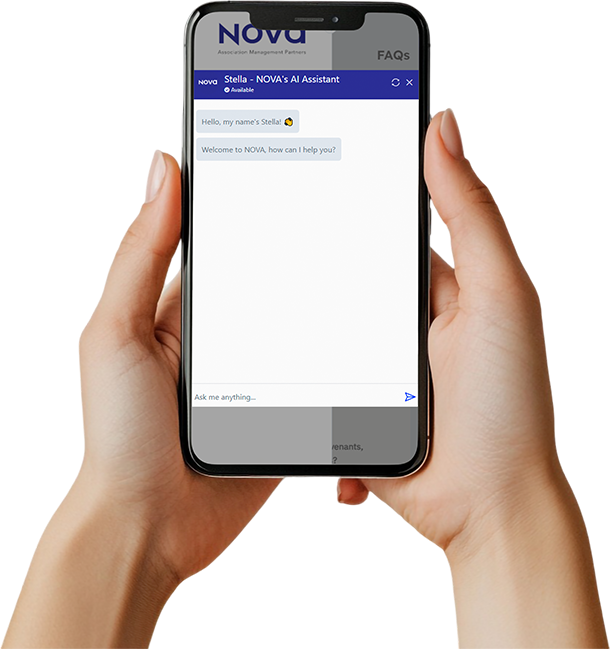
Ask Stella Anything
Our digital assistant is here for you day or night to answer questions and deploy solutions immediately.