RESOURCE CENTER
Home / Board Resources / HOA Management Education
BOARD MEMBER RESOURCES
The Ultimate Guide to HOA Management
HOA management is one of those things that sounds simple until you’re actually responsible for it.
A community needs someone to keep an eye on the budget, manage vendors, answer homeowners, maintain common areas, prepare for board meetings, and make sure the association stays on top of its responsibilities. And when something goes wrong, the board is usually the first place homeowners turn for answers.
Every community has its own set of headaches. In one neighborhood, the biggest issue might be keeping up with the pool and landscaping. In another, the board could be dealing with aging roofs, several amenities, and hundreds of homeowners. The management support that works for one community may not make much sense for another, so it’s important to understand what your association actually needs before choosing a management company.
What people mean when they say “HOA”
When most people say “HOA,” they really mean the organization responsible for running their neighborhood.
In a single-family HOA, that usually means the association is responsible for things such as common areas, entrance landscaping, private roads, amenities, and the rules that apply to the community. Your house and your lot are still yours to maintain.
Condominium ownership adds another layer because the association is responsible for parts of the building itself. Take a roof leak. If water comes through the ceiling of a unit, the owner may assume she needs to call a contractor and pay for the damage. But the roof may actually fall under the association’s responsibility, depending on the governing documents and state law. The cost can then become an association expense rather than something that falls entirely on the individual homeowner.
That’s one of the big differences with condo living. There’s less individual exterior maintenance to worry about, but the building itself is a shared responsibility.
Townhome communities can fall somewhere in between. Owners are generally responsible for their own interiors while the association takes care of certain exterior areas and common elements. That line between “mine” and “the association’s” is also where plenty of questions—and arguments—begin.
Then there are master-planned communities with a master association overseeing several smaller associations. A board that is used to making its own decisions can be surprised to learn that some of those decisions actually fall under the master association.
A mixed-use development brings another layer into the picture because commercial properties and residential owners are sharing the same overall development. The issues that come up can be very different from those in a typical residential neighborhood.
Gated neighborhoods, large-scale communities, and planned unit developments have their own considerations as well.
Before you compare your community to another one, make sure you’re actually comparing similar communities. The management needs of a 75-home neighborhood can look very different from those of a 2,000-home development with multiple amenities and layers of associations.
The board member side of the job
Being on an HOA board is supposed to be a volunteer commitment. It shouldn’t feel like taking on a second job.
But it can get that way pretty quickly.
A board member might spend a Tuesday night chasing down a vendor quote. The next day, there’s a homeowner asking about a violation. Then someone needs a copy of an old document, the budget needs another look, and the board has a meeting coming up.
Most people who volunteer for a board aren’t looking to become experts in contractor requirements, reserve funding, insurance, and association law. They’re homeowners who want to help their community run well.
Our Board Member Experience® is built around making that job easier. Meetings should be organized. Board members should be able to find the records they need. And when a complicated decision comes up, they should have someone who can help them understand their options rather than simply handing over a stack of information.
Good management gives board members room to actually be board members.
Without that support, the hours can add up fast. What starts as a few calls a month can turn into evenings occupied dealing with vendors, homeowner questions, paperwork, and problems that probably should have been handled before they reached the board.
It’s not surprising that some communities end up with the same people serving year after year simply because nobody else wants to take on the workload.
The homeowner side of the job
A homeowner submits a request to build a new fence and waits.
A few days go by. Then another week. Three weeks later, someone finally responds.
By then, the homeowner is frustrated. She may not know why the request took so long. She just knows she had to wait three weeks for an answer.
The same thing happens with plenty of everyday HOA questions. A gate needs to be repaired. Someone wants to know what’s happening with a maintenance request. A homeowner has a question about a bill or needs a copy of a document.
The individual request might be small, but the experience still matters.
If a homeowner has to send the same email twice or make three calls to get an answer, that experience sticks with them. The opposite is true, too. When someone responds quickly and actually follows through, homeowners notice that as well.
That’s a big part of the Homeowner Experience®. Homeowners should have a straightforward way to get help, and when the answer is already available, they should be able to find it themselves through a community portal instead of waiting on hold.
Good communication won’t eliminate every complaint. It can make a big difference in how those complaints are handled.
Where the money goes
Financial management is one of those HOA responsibilities that tends to get attention when something goes wrong.
Consider a board that increases its budget by two percent every year because that’s roughly what it did the year before. Then insurance renews at a much higher rate. A major repair comes up. The reserve study is several years old.
Suddenly, the numbers don’t work anymore.
Maybe the roof needs to be replaced, and the current bid is three times what the association expected. Maybe a major concrete project costs far more than the board had planned for.
Good financial management means paying attention to those changes before they become emergencies.
Boards should be able to see where the money is going, understand why expenses changed, and get a clear picture of what’s available for future projects. Budgets shouldn’t simply be copied from the previous year, and reserve planning shouldn’t be something the board remembers only when a major repair is already on the horizon.
The goal isn’t just to produce financial statements. It’s to give the board information it can actually use to make decisions.
Why the one-person model tends to fail
There’s a simple problem with putting everything on one person: eventually, that person won’t be available.
Maybe they’re on vacation. Maybe they’re sick. Maybe they’re dealing with another community’s emergency. Whatever the reason, the board shouldn’t suddenly find itself unable to get an answer because one manager was the only person who knew what was going on.
The traditional model often puts too much on one manager. One manager ends up handling vendor calls, inspections, paperwork, project follow-up, and just about everything else.
We take a different approach.
An Association Manager handles the work that requires experience and judgment, including board strategy and community decisions. An Association Coordinator provides additional support with projects and escalations. Our Solution Team handles many of the everyday homeowner questions that would otherwise end up in the manager’s inbox.
The team can access the same records, too. So if a homeowner calls on Friday instead of Tuesday, they don’t have to start from scratch with someone who has never seen the issue before.
That kind of coverage matters. Your community shouldn’t depend on one person never taking a day off.
The technology piece
Technology doesn’t replace a good manager. It does make it easier for everyone to do their job.
Take community records. A board member who joined last year shouldn’t have to rely on another volunteer’s memory to understand why a decision was made in 2019. Important records should be accessible and searchable.
The same goes for property inspections.
Instead of relying entirely on someone’s notes from a site visit, communities can use scheduled video documentation to keep a record of what’s happening on the property. An Association Coordinator can review that information and flag issues that need attention. If a homeowner later questions a violation, there’s documentation to refer back to.
That doesn’t mean every situation can be solved by technology. It can’t.
The point is to give managers and boards better information before they make a decision.
HOA laws vary by state
Association rules aren’t the same everywhere.
A board member who moves from one state to another can’t assume that the rules from their old community will apply in the new one. HOA and condominium laws vary by state, and they can change over time.
That’s particularly important when boards are dealing with issues involving assessments, meetings, records, insurance, elections, or other areas governed by state law.
If you’re comparing how another community handles an issue, find out what state laws apply to that community before assuming the same approach will work for yours.
You can also check our service area pages for more information about the communities we serve.
What happens when you switch management companies
Boards often put off changing management companies because the idea of switching feels like a nightmare.
Honestly, a poorly planned transition can be one.
There are bank accounts to deal with, financial records to reconcile, governing documents to collect, homeowners to notify, and a new portal to set up. Nobody wants to find out on the first day of a new contract that half the information never made it over from the old company.
That’s why the transition should start before the official takeover date.
We begin the process when the agreement is signed. During the roughly 30 days before the official start date, our team works through the community’s records, financial information, governing documents, and systems so the transition isn’t being figured out at the last minute.
Homeowners hear from us before the change happens, too. They know who the new management company is, where to send payments, and what to expect.
The board gets training during that period as well.
Then, around 60 days after the transition, we check back in with the board. By that point, everyone has had some time to see what’s working and where there are still problems.
That’s the idea behind our customer success and onboarding process. Changing management companies shouldn’t feel like the community is being dropped into the deep end on day one.
What to look for in a management partner
Before you sign a management agreement, ask some very specific questions.
Start with the manager’s workload. How many communities does that person handle? What happens when they’re out of the office? Who steps in if a board needs help while the manager is unavailable?
A company should have a reasonable limit on how much one manager can take on. If managers are constantly being given more communities, eventually something is going to get missed.
Training is worth asking about, too. Association laws and best practices change. Find out how the company keeps its managers current and whether they participate in organizations such as the Community Associations Institute.
And if the company will let you, attend one of its board meetings before you make a decision.
You can learn quite a lot by watching a manager work through a real meeting. Are the questions answered clearly? Does the meeting stay organized? Do board members seem comfortable asking questions? Does the manager know when to offer advice and when to let the board make the decision?
That tells you much more than a sales presentation.
Price matters, of course. But the lowest management fee doesn’t necessarily mean the lowest cost for the community. If a cheap management arrangement leaves board members doing work themselves, or if problems keep getting missed, the savings can disappear pretty quickly.
Look for a company that can provide the level of support your community actually needs—and one that can keep good people in those roles.
NEXT STEP
Ready to talk through your community’s specific situation?
Every community has its own challenges. A 50-home neighborhood doesn’t need the same management structure as a large master-planned community, and a condo association has very different responsibilities from a single-family HOA.
If your board is considering a management change, dealing with ongoing problems, or simply wondering whether there’s a better way to handle the day-to-day work, contact our team.
We can go through what your community needs and explain our customized management solutions.
Frequently asked questions
What does HOA management cover?
HOA management can include financial management, vendor management, homeowner communication, maintenance oversight, records, compliance, board support, and the many day-to-day tasks that keep an association running.
How much should we budget for reserves?
There isn’t one percentage that works for every community. The right reserve amount depends on what your association owns, the age and condition of those assets, expected replacement costs, and other factors.
A reserve study is integral to help the board understand what major expenses are coming and how much should be set aside for them. It’s also important to keep that information current rather than relying on an old study indefinitely.
What’s the difference between an HOA, a condo association, and a POA?
The biggest difference is what the association is responsible for.
A single-family HOA generally manages common areas and community amenities, whereas homeowners maintain their own homes and lots. A condo association has responsibility for shared parts of the building, which can include roofs, exterior elements, elevators, and other common components.
A POA, or property owners association, is a more general term that can apply to different types of planned communities and developments.
The governing documents and state law ultimately determine who is responsible for what. That distinction matters because getting the responsibility wrong can affect everything from maintenance to insurance.
Can we switch management companies without disrupting the community?
Yes, but the transition needs to be planned.
A good management company should start gathering records, reconciling financial information, setting up systems, and communicating with homeowners before the official takeover date. The earlier that work begins, the less likely the transition is to create problems for the board or residents.
Our customer success and onboarding process is designed to handle that transition before the new management relationship officially begins.
What makes Nova’s approach different from other management companies?
Our approach is built around having a team rather than asking one manager to handle every issue for an association.
The Association Manager can focus on board-level decisions and strategy while other team members handle homeowner questions, project support, and other day-to-day needs. That gives the community more coverage and means the entire relationship doesn’t depend on one person being available every day.
We also emphasize ongoing training and involvement with organizations such as the Community Associations Institute so our team can keep up with changes affecting community associations.
Keep learning
Related Guides & Resources
Nova Association Management
Your board should be governing—not running the day-to-day operation.

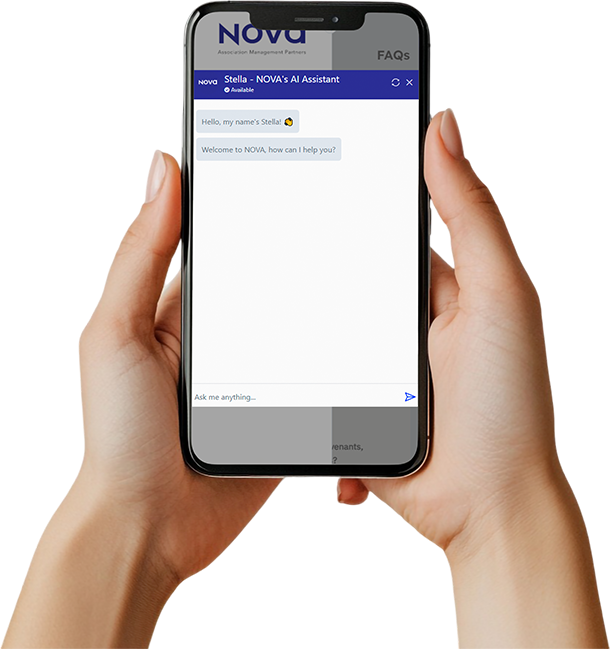
Ask Stella Anything
Our digital assistant is here for you day or night to answer questions and deploy solutions immediately.