RESOURCE CENTER
Home / Board Resources / HOA Management Education
BOARD MEMBER RESOURCES
What Does an HOA Management Company Do?
A new board president opens the latest management invoice and has a pretty reasonable question: what exactly are we paying them to do?
It can be hard to tell from the outside. Residents see the management company when they have a question, need a form, or receive a notice. Board members see a little more: financial reports, meeting preparation, vendor issues, and the occasional problem that somehow becomes an emergency at 4:30 on a Friday.
There’s a lot happening in between.
An HOA management company handles much of the operational work that keeps a community moving while the board stays responsible for the decisions that belong to it. The exact responsibilities vary from one company and community to another, but the work generally touches finances, vendors, maintenance, meetings, homeowner communication, records, and compliance.
Managing the money
Financial management is one of the most visible parts of an association management contract, but it goes well beyond collecting dues and paying bills.
The management company may handle accounts receivable, collections, accounts payable, financial reporting, budgeting and other day-to-day accounting responsibilities. The goal isn’t simply to keep transactions moving. The board should be able to understand where the association stands financially and what needs attention.
Budgeting is a good example. Insurance, utilities, landscaping, repairs, and other operating costs don’t necessarily increase at the same rate every year. A budget copied from last year’s spreadsheet can look perfectly reasonable until the actual bills start coming in.
Nova’s financial management services include budget preparation, accounts receivable and collections, accounts payable, fund reporting and tax and audit support. The company’s approach is also to explain the reasoning behind financial recommendations rather than simply handing a board a number and expecting them to approve it.
That’s particularly important when a board is looking at a major expense or trying to figure out whether its reserves are keeping pace with future needs.
Preparing for better board meetings
Nobody volunteers for an HOA board because they dream of spending Tuesday night sorting through meeting paperwork.
A good management company helps keep the business of the association organized before the meeting even starts. That can include preparing agendas, gathering supporting documents, tracking action items, and taking minutes so there is a useful record of what was discussed and decided.
Nova calls this Meeting Optimization™. The idea is to treat a board meeting as a professional business meeting rather than an informal gathering where everyone works out what needs to happen as they go. Nova’s Board Member Experience® is built around that approach, with managers focused on helping boards make decisions and move community business forward.
That distinction matters. A board shouldn’t have to spend its limited meeting time figuring out what happened last month. The information should already be there.
Answering homeowner questions
Then there is the part of management residents interact with most often.
Some issues, like a resident locked out of the community gate or a question about a violation notice, do not typically require board intervention. Nevertheless, they demand prompt, reliable handling.
That’s where Nova’s Homeowner Experience® and Solution Team come into the picture.
Instead of sending every homeowner question directly to an Association Manager, Nova separates the day-to-day owner experience from the board-facing management work. The Solution Team handles homeowner interactions, while Association Managers can spend more time with the board working on larger issues and decisions.
That structure is intentional. When every question goes to one person, routine requests can quickly crowd out the work that requires a manager’s real experience and judgment.
Keeping vendors and maintenance moving
Communities have a long list of things that need attention: landscaping, pools, gates, irrigation, repairs, inspections and larger capital projects.
The management company coordinates with vendors, follows up on work, helps obtain bids and brings issues to the board when a decision is needed. It also means somebody is paying attention when the contractor who was supposed to show up Tuesday doesn’t.
For a larger project, the manager’s role isn’t simply to forward a proposal to the board. Nova’s team works with boards on vendor relationships and recommendations, including helping them understand the options before a decision is made. The company’s Board Member Experience® blueprint specifically includes Vendor Relations and data-driven solutions as part of that work.
Routine maintenance may be less exciting than a major capital project, but it is often what residents notice first when management isn’t keeping up.
Handling compliance and community rules
HOA rules don’t enforce themselves.
A management company can help the association follow its established process for inspections, notices, and violations, while the board remains responsible for the policies and decisions that belong to it.
This is another area where having good records matters. If a homeowner questions a violation notice six months later, the association should be able to see what was observed, when it happened, and what action was taken.
Nova supports property inspections and compliance work with regular video documentation. Cameras mounted on vehicles capture property footage, which our team members review for potential violations. Because the footage is retained, a historical record is created that can be reviewed later.
That gives the management team something more useful than memory alone when questions come up.
Keeping the records organized
Association records have a way of becoming important at exactly the moment nobody can find them.
A new board member may want to know why a decision was made several years ago. A treasurer may need to understand a past financial transaction. A homeowner may need a governing document or other community information.
Nova’s approach is to keep those records accessible through its cloud-based systems so the board isn’t dependent on one person’s inbox or a filing cabinet that only one manager knows how to navigate. Board members can access historical discussions and documents through the portal, and the management team works from the same information.
That shared access also solves a less obvious problem: continuity.
If one person is out of the office, the association shouldn’t suddenly lose access to its own history.
Why Nova uses a team instead of one manager
The traditional management model puts a lot on one person’s desk.
The same manager may be expected to answer homeowner calls, attend board meetings, inspect the property, chase vendors, review financial information, and deal with whatever problem showed up that morning. Even a very good manager eventually runs into a capacity problem.
Nova built its model differently.
Association Managers focus primarily on the board relationship, strategy, and decisions that require management expertise. Association Coordinators provide project and escalation support. The Solution Team handles much of the day-to-day homeowner experience.
The idea is pretty straightforward: don’t overload the person who is supposed to be helping the board.
What the board should expect to see
A management company should make the board’s job clearer, not make it harder to see what’s going on.
Regular financial reporting, organized records, updates on projects and maintenance, clear communication about issues that need board attention, and providing enough information for board members to make informed decisions are an integral part of what a management company should be doing for the board.
It also means knowing where the management company’s responsibility ends.
The board still governs the association. It approves budgets, makes policy decisions, and retains the authority provided by the governing documents and applicable law. The management company handles the operational work and provides recommendations and support so the board can do its job effectively.
That’s an important distinction. Management supports the board. It doesn’t replace it.
What happens when you first hire a management company?
The work should begin before the official management start date.
Nova’s onboarding process starts when the agreement is signed. During the transition period, the team gathers community information, reviews documents, and prepares its systems. Homeowners are introduced to the new management team, and Nova meets with the board to align on goals and provide training.
After management begins, the relationship doesn’t simply get handed off and forgotten. Nova schedules a 60-day success review to look at progress, gather feedback, and adjust the approach where needed.
That matters because taking over an association isn’t just an administrative change. There are years of records, vendor relationships, financial information, and community history to understand.
The goal isn't to run the community for the board
The best management relationship doesn’t leave board members wondering what their management company is doing all month.
It gives them enough visibility to understand what is happening without requiring them to manage every detail themselves.
That’s the thinking behind Nova’s Board Member Experience®: give volunteer board members the tools, information, and professional support they need to lead effectively without turning the role into another full-time responsibility. Nova’s stated goal is for board members to spend roughly an hour a month on board responsibilities rather than carrying the operational workload themselves.
The result should be a board that can focus on the decisions that belong to it, while the management team handles the work required to carry those decisions out.
NEXT STEP
Ready to see what management could look like for your community?
There isn’t one management package that makes sense for every association. Nova works with communities ranging from small associations to communities with thousands of units and positions its services around customized management solutions rather than a one-size-fits-all model.
If you’re considering professional management, or wondering whether your current arrangement is doing enough, contact the Nova team to talk through your community’s needs.
Frequently asked questions
Do all HOA management companies offer the same services?
No. Management agreements can differ quite a bit. One company may handle financials and collections but leave homeowner communication or other responsibilities with the board. Another may provide a much broader range of operational support. Read the actual scope of services in the agreement and ask what is included before comparing proposals.
How much control does the board keep?
The board remains responsible for governing the association and making decisions that fall within its authority. A management company carries out those decisions and provides administrative support, recommendations, and day-to-day management. The management company shouldn’t replace the board’s role.
What doesn't an HOA management company do?
A management company shouldn’t make major decisions about the association’s money, governing documents, or policies on its own. Those decisions belong to the board. The management company’s role is to provide information, recommendations, and operational support so the board can make those decisions.
Why does Nova use a team-based management model?
Nova separates responsibilities among Association Managers, Association Coordinators, and the Solution Team. Managers can concentrate on board-level work while coordinators provide project and escalation support and the Solution Team handles homeowner interactions. The model is designed to reduce the amount of routine work sitting on one manager’s desk.
How is Nova different from a typical HOA management company?
Nova’s approach centers on customized management, a team-based structure, and separate experiences for board members and homeowners. The company also emphasizes manager capacity, shared access to community information, and video-based property documentation to support inspections and compliance.
Keep learning
Related Guides & Resources
Nova Association Management
Your board should be governing—not running the day-to-day operation.

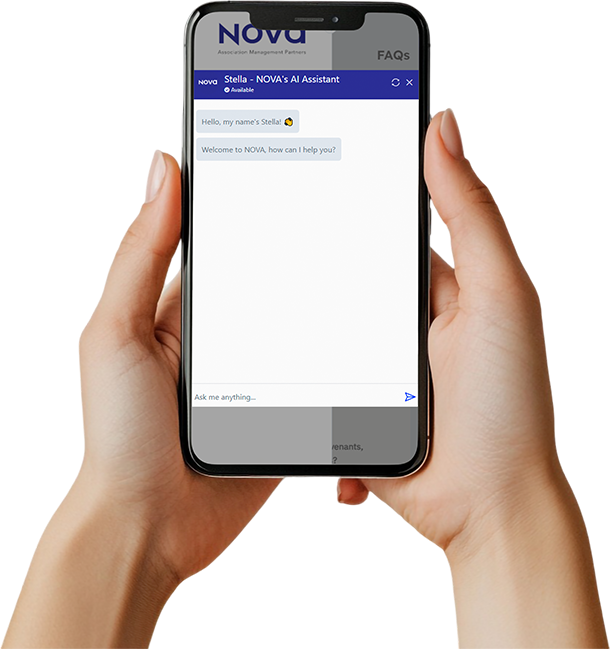
Ask Stella Anything
Our digital assistant is here for you day or night to answer questions and deploy solutions immediately.