Home / Board Resources / Developer Education
BOARD MEMBER RESOURCES
Developer Services Guide
Most developers hire a management company about a month too late.
The first closing is the usual trigger. Somebody realizes homeowners are about to move in, the pool needs a maintenance contract, the insurance has to be in force, and nobody has told the buyers who to call when the gate doesn’t open. By then the association is already operating, and every decision made in a hurry becomes part of its history.
Developer services exist to move that conversation earlier. In short, professional management for a new community should start before construction ends, and it should stay in place through the sales period and the handoff to homeowners. The sections below follow that timeline, from the first plans through turnover. If you’re newer to the topic, our full guide to HOA management explains how associations work once they’re running.
Why management belongs in the planning stage
A development plan decides more about an association’s future costs than most developers realize. The amenities, the common-area layout, the landscaping, and the quality of the infrastructure all become line items that homeowners pay for year after year. A clubhouse with a full kitchen costs something different to operate than one without, and a long private road costs something different to repave than a short one.
Nova’s Developer Services begin with that review. The team looks at development plans for their management impact and treats amenity design as a cost driver. It builds budgets from data on comparable communities, so the projections reflect actual management costs and not generic estimates. Insurance, vendor costs, and reserve planning all get settled before the first closing, because they’re far easier to get right when nobody is living there yet.
Governing documents get the same treatment. Rules that sound reasonable on paper can turn out to be hard to enforce in practice, so an operational perspective during drafting saves trouble later.
Building the first budget
An association’s first budget is a forecast with no history behind it. It has to account for partial occupancy, since a community with a third of its homes sold doesn’t cost the same to run as a full one. It also has to account for amenities that open in stages, and for the point at which the developer stops subsidizing part of the cost.
Reserve planning belongs in that first budget too. It’s tempting to leave it for later, since nothing looks like it needs replacing yet. Nova begins reserve planning at the start of a community’s life, even when major capital needs are years away, because funding from the start helps the community avoid special assessments down the road. Our article on building the first HOA budget walks through the numbers in more detail. Nova’s financial management team handles the accounting with local experts who know the regulations in each market, and the reports are written so developers, board members, and homeowners can all read them.
Getting ready before move-in
The weeks before the first closing are when an association either looks organized or doesn’t. Systems, vendors, insurance, and communication channels should be ready before the first homeowner arrives, and the initial budget should be in place with assessment collection set up.
Vendor contracts deserve special care. Signed early, they can be written to fit the community as it exists on day one and to scale as new phases open, so the association isn’t renegotiating each time the neighborhood grows. Early homeowners also need a clear picture of what to expect, including construction disruption and amenity timelines. A buyer who closes in March and hears the pool won’t open until August would rather hear it in March.
Nova sets up cloud-based systems for financial tracking, document management, and communication from the beginning, so the operation doesn’t have to be rebuilt as the community grows.
Managing through the phases
Large projects rarely finish all at once. A master-planned community may release sections over many years, and a large-scale community can have different parts at different stages of life. Operations have to keep adjusting as each phase opens, and residents who already live there need to hear about it before the construction trucks do.
Developers also have prospective buyers to think about. The people touring a model home are often watching how the community runs around them, so communication that reaches both current residents and future buyers matters. Nova supports developer-appointed boards during this period, and elected boards when they come into the picture.
Supporting the sales effort
A well-run community sells homes. Prospective buyers notice whether the common areas are maintained, whether the amenities operate smoothly during tours, and whether current residents seem happy. Satisfied residents also tend to become referrals and reviews, which any developer with remaining inventory has reason to care about.
Defined roles help here. When the sales team and the management team each know what belongs to them, a buyer’s question about the pool gets an answer from the person who runs it. Construction decisions matter as well. Infrastructure that is built well costs less to maintain, and a management partner who has seen similar communities age can say where it will show up.
Documenting construction and operations
Disputes over construction impact and timelines are common in communities that are still being built. Nova’s regular video documentation of construction phases, amenities, and infrastructure gives developers and boards an objective record to point to when memories differ. The same cloud-based systems keep financial records, vendor contracts, and correspondence organized as they accumulate, which makes the eventual handoff cleaner.
Planning for turnover
Turnover is the point where the developer hands the association to homeowners, and it’s easier to plan for than to improvise. Governing documents and state law set the milestones, which Nova tracks so the timing doesn’t depend on anyone’s memory. The rules differ across Washington, Oregon, and Montana, and the service area pages show how Nova works in each.
Before turnover, Nova educates homeowners who plan to serve about what board service involves and how the association operates. Financial transitions are handled with clear documentation, vendor relationships and insurance and legal requirements are transferred, and first elected boards get guidance after the handoff.
Four articles cover the topic in detail. Start with the overview of the transition from developer to homeowners, then use the developer turnover checklist as a working document. The article on common transition mistakes covers what goes wrong, and the piece on the first budget explains why the early numbers matter so much.
What a new board needs after the handoff
Developers sometimes assume their job ends at turnover. For the association, the work is just starting, and a first board will be judging the developer partly on how the handoff goes. Records that are organized and a budget with no surprises make for a good first impression, as does a management team that stays in place so the community doesn’t lose its continuity.
Nova’s Board Member Experience® keeps the volunteer role manageable, with agendas and supporting documents reaching board members ahead of time and a goal of roughly an hour a month on board responsibilities. The Homeowner Experience® gives owners a way to reach the Solution Team at any hour, which keeps routine requests away from the board. The onboarding process starts thirty days before management begins and includes a 60-day success review.
Questions to ask a management partner
Not every company that manages associations has worked with developers, and the difference shows up quickly. It’s reasonable to ask whether they’ll review your plans before construction ends, how they build a first-year budget when there’s no history, and who is responsible for the turnover timeline. Ask how vendor contracts are structured so they scale, and who answers when a homeowner calls on a Sunday.
Community type matters too. A condominium has shared structures and insurance that need more attention than a street of townhomes, and a mixed-use project has different needs again. A partner should be able to explain how its approach changes with the project.
NEXT STEP
Ready to talk through your project?
Whether you’re still sketching plans or a few months from your first closing, reach out to our team and we’ll walk through what developer support could look like. Our customized management solutions are built around the fact that no two communities need the same thing. For more on how associations work after the handoff, the full guide to HOA management is a good next read.
Frequently asked questions
When should a developer bring in a management company?
Before the first closing, and ideally during planning. Budgets, insurance, vendor contracts, and reserve planning are all easier to set up before homeowners are living in the community.
What does an HOA developer services program include?
At Nova it covers pre-construction planning, start-up and early operations, management through development phases, and transition planning and turnover. It also includes support during the sales period.
How does the first budget get built with no history?
From data on comparable communities, adjusted for partial occupancy and staged amenity openings. Reserve planning is included from the beginning.
Who controls the association during development?
The developer appoints the board until turnover. The governing documents and state law determine when control passes to homeowners.
Does management help with turnover?
Yes. Nova tracks turnover milestones, educates homeowners who plan to serve, documents financial transitions, and supports the first elected board afterward.
Keep learning
Related Guides & Resources
Nova Association Management
Your board should be governing—not running the day-to-day operation.

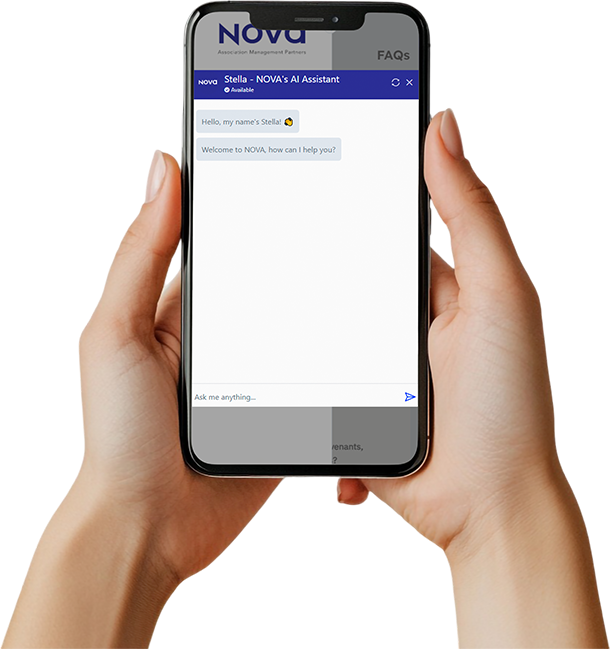
Ask Stella Anything
Our digital assistant is here for you day or night to answer questions and deploy solutions immediately.