Home / Board Resources / Developer Education
BOARD MEMBER RESOURCES
HOA Transition from Developer to Homeowners
Every new community starts out run by the people who built it.
Turnover is the point where control of the association passes from the developer to the homeowners who live there. It happens at milestones set by the governing documents and state law, and a board that arrives to organized records and realistic reserves starts in a far better position than one that inherits a pile of boxes. For the broader picture of how association management works across community types, our full guide to HOA management is a good place to begin.
Who runs the association before turnover
Until turnover, the developer appoints the board. A developer-appointed board operates differently from an elected one, since its members often work for the developer, the early budget reflects what the developer expects to spend while homes are still being sold, and the owners who have closed so far have limited say in most decisions. That structure exists so a project can get built and sold, and it works fine for that purpose. It also explains why the first elected board so often learns how the community has really been run only after it takes over.
Nova’s Developer Services start well before that moment, and they cover association setup, budget development, governing document implementation, vendor procurement, and homeowner onboarding, from the start of construction through the handoff to a homeowner board.
What triggers the handoff
The governing documents and state law set the milestones. Most tie turnover to the sale of a share of the units, to a date, or to both, and the specific numbers differ between states and between condominium and planned community structures. Washington, Oregon, and Montana don’t follow the same rules, so the service area pages make a useful starting point, and the community’s attorney can confirm what applies to a particular project.
Phased projects add a wrinkle, because a community built over several years may hand over in stages. Nova tracks the turnover milestones laid out in the governing documents and adjusts operations as each new phase comes online. That matters most in large-scale communities and master-planned communities, where one section can be fully homeowner-governed while another is still under developer control.
Planning that starts years before turnover
The work that makes a handoff go smoothly happens long before anyone schedules a turnover meeting. Insurance requirements, vendor costs, and reserve planning get settled before the first closing, and the vendor contracts are set up to fit the project’s current phase and grow with it. Documentation gets organized as it’s created, which spares the new board from paying for a cleanup project after the fact.
Budgeting deserves its own attention. Some early budgets lean on the developer covering part of the cost of running the community, and those numbers can look very comfortable right up until the developer stops covering the gap. A board that sees the real cost of operating the community before turnover has time to bring assessments up gradually, whereas a board that sees it afterward has to do it all at once. Nova’s financial management approach is built to make community accounting accessible for developers, board members, and homeowners alike, with local experts who know the regulations in each market.
The records a new board should receive
Documents are the hard part of any handoff. A new board should expect the recorded governing documents and any amendments, along with the association’s financial statements and budget history. Insurance policies and the vendor and service contracts come next, followed by the plans and as-built information for the common areas and whatever warranty paperwork exists for the buildings and systems. If a reserve study has been done, the board needs that too.
Missing paperwork is the usual problem. When records have lived in the developer’s files instead of the association’s, the new board ends up requesting them one piece at a time, and some of them never turn up. Nova keeps association records in a cloud-based system from the start, so financial records, vendor contracts, meeting minutes, and historical correspondence are already organized when the board takes over.
Reserves and the first real budget
Reserves tend to be the biggest surprise. A reserve study estimates what the common elements will cost to repair and replace over time, and a board holding one can see how much the assessments need to cover as the buildings age. When nobody has commissioned a study by the time of turnover, getting one done early gives the new board a baseline to work from. Nova connects boards with reputable specialists for reserve studies, and walks through the reasoning behind its budget recommendations with supporting documents, so the board understands the numbers before it votes on them.
Construction questions
New boards sometimes find defects in the common elements, and whether to pursue a claim against the developer or builder involves legal deadlines that can run out faster than people expect. That is a matter for the association’s attorney, often alongside an independent inspection, and a board shouldn’t wait on it. Management can pull together the maintenance history and vendor records that support the review, but the legal and engineering questions belong with the professionals who handle them.
Getting homeowners ready to serve
Homeowners who have never sat on a board need to know what the job involves before they agree to it. Nova’s pre-turnover preparation is meant to get homeowners ready for governance responsibilities, and the Board Member Experience® keeps the job manageable once they’re in it. Under Meeting Optimization™, agendas and supporting documents reach board members ahead of time, and the Association Manager arrives prepared, so a first-time board isn’t piecing together its first meeting from scratch. Nova’s goal is for board members to spend roughly an hour a month on board responsibilities.
The first meeting after turnover usually covers electing officers, reviewing insurance, going through the vendor contracts, and looking at the budget. A new board that handles those four in order has done most of what it needs to do in its first month.
The first months after turnover
Nova’s transition work begins ahead of the formal management start date. In the thirty days before management begins, the team sets up its systems, prepares homeowner communications explaining the change, and reviews vendor contracts, financial documents, and governing paperwork. The board meets with the team to align on goals and get training, and that process is laid out in the onboarding process.
Support continues past the transition date. A 60-day success review looks at how things are going, and Nova keeps checking in after that, so the community has continuity while governance shifts from developer to homeowners.
NEXT STEP
Planning a handoff, or about to inherit one?
Every turnover looks a little different, depending on the size of the project, how many phases it has, and how much of the groundwork was done early. If your community is approaching turnover, or you’re a developer planning for it, reach out to our team, and we’ll talk through how our customized management solutions fit your situation. The full guide to HOA management covers the rest of what community management involves.
Frequently asked questions
When does a developer have to turn over the HOA?
The governing documents and state law decide. Many tie turnover to the sale of a certain share of the units or to a set date, and some communities hand over in phases. The community’s attorney can confirm the exact trigger for a specific project.
What should a new board ask the developer for?
The governing documents and amendments, financial statements, budget history, insurance policies, vendor contracts, plans for the common areas, and any warranty paperwork. A reserve study belongs on that list as well. Asking for everything in writing, with a date, gives the board a record if something goes missing.
Can the developer stay involved after turnover?
Often a little, yes. A developer who still owns unsold units usually keeps the voting rights that come with ownership, and the governing documents may preserve other limited rights. The documents spell out what continues.
Does a community need a management company at turnover?
The law doesn’t require one in most cases, and some boards self-manage. Turnover is the moment when records, vendors, and financial accounts all change hands at once, which is why many new boards bring in professional management for that stretch.
How long does a transition to a management company take?
Nova starts when the agreement is signed. The thirty days before the management start date go to setting up systems, communicating with homeowners, and reviewing documents, and the 60-day success review follows once management has begun.
Keep learning
Related Guides & Resources
Nova Association Management
Your board should be governing—not running the day-to-day operation.

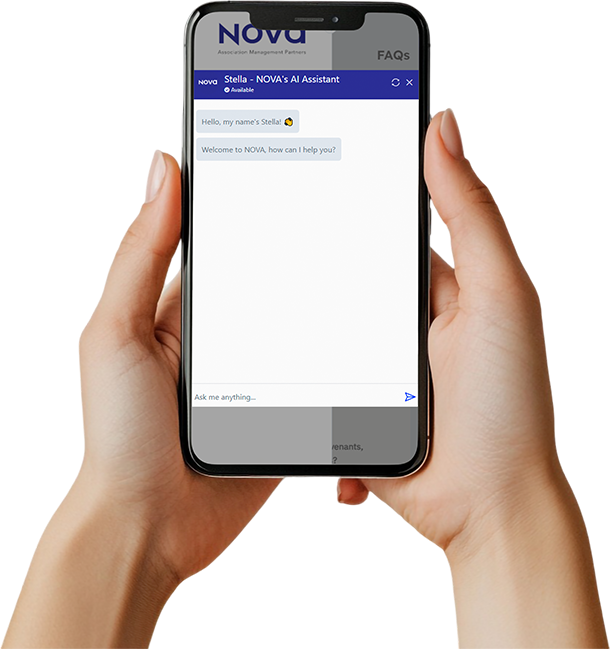
Ask Stella Anything
Our digital assistant is here for you day or night to answer questions and deploy solutions immediately.